 The Discus | Discus Fish Care and Breeding Guide
Snakeskin vs. Leopard Discus: Patterns and Buying Tips
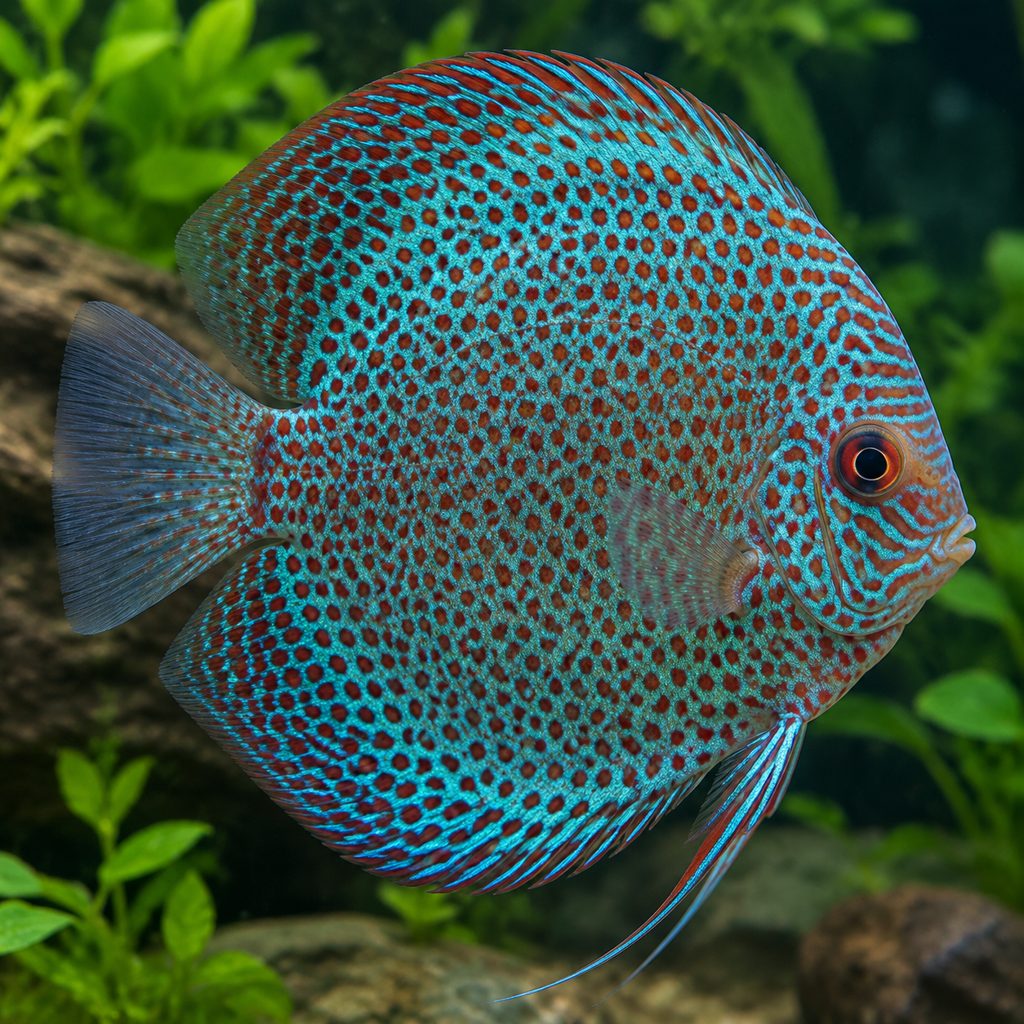
Snakeskin and leopard discus are pattern types, not separate care categories. Snakeskin is associated with fine, closely spaced lines; leopard types show spots across the body. If you are comparing fish, look at the pattern across the whole flank and consider how the fish behaves. A dramatic patch or a dark stress bar is not enough to judge the quality of a pattern.
Reading snakeskin linework
The name “snakeskin” refers to fine markings that resemble scales. Lines can be assessed for fineness, density, and how evenly they cover the body. A fish with a dense pattern in one area and sparse markings elsewhere may look less uniform than one whose linework is balanced across the flank. View both sides when possible; a photograph can hide differences in density or symmetry.
The number 14 is sometimes used as a reference for the vertical bars along the body. These bars are also called stress bars, and their darkness can change with the fish’s condition and surroundings. Do not confuse changing bar contrast with the fine line pattern itself. Count and alignment may help describe a fish, but neither the count nor the current darkness of the bars alone establishes pattern quality.
Leopard spots and combination strains
Leopard discus have spots rather than the fine lines characteristic of snakeskin. Compare spot size and distribution over the whole body. A few bold marks can draw attention away from uneven spacing elsewhere, so step back and judge the overall impression.
Some selectively developed strains combine pattern types. Pigeon snakeskin is a cross between pigeon and snakeskin lines and can show characteristics of both. U.S. specialist catalogs use names including “Leopard,” “Snakeskin,” “Leopard Snakeskin,” and “Pigeon Snakeskin.” These are useful retail search terms, but the catalog naming does not establish one objective grading standard shared by all sellers.
| Pattern feature | What to look for |
|---|---|
| Vertical bars | The 14-bar reference is sometimes used; consider condition and contrast |
| Snakeskin lines | Fine, dense markings distributed evenly |
| Left-right balance | Similar overall pattern impression on both sides |
| Leopard spots | Compare spot size and arrangement across the flank |
The reference table is a way to organize what you see, not a formal scorecard. A calm fish may show different stress-bar contrast than it does after transport or a change in surroundings. Look for the fixed linework or spots separately from temporary changes in the bars. For body shape, see our article on high-body discus; pattern and form are separate traits worth assessing together.
U.S. listing examples and what prices mean
Online specialist sellers provide one direct-to-consumer route for finding named strains. On October 12, 2026, one U.S. seller listed “Golden Pearl Pigeon Snakeskin Discus” at $67–$109. Its “Golden Pigeon Leopard Discus, White Base” and “Golden Leopard Discus, Light Base” listings each showed $44–$155. These are seller-specific price ranges, not market averages, and the retrieved listings did not show stock status. Price variation within a listing can reflect differences among the fish offered; check the individual listing and ask what is currently available.
The seller’s catalog verifies that these names are used in retail listings, not that every seller uses them identically. Before buying, ask for current photos or video of the exact fish if available. View it in a relaxed state, compare both sides, and assess swimming, breathing, and feeding along with pattern. A useful purchase decision considers health and balance, not only a label or price.
Wild fish and imported arrivals
Wild discus come from different locations and water conditions, so no single pH value applies to all wild fish. A pH range of 4.5–6.5 is sometimes cited for wild waters, but it is not a fixed requirement for every wild discus. Imported fish may need quarantine and a period of stabilization. Observe the individual and establish its condition rather than assuming the pattern name tells you how it was kept. Our article on transporting and moving discus covers acclimation and arrival care.
FAQ
What is the reference for a snakeskin pattern?
Fine, closely spaced lines are the defining visual feature. A 14-bar reference is sometimes used for the vertical bars, but their darkness varies with the fish’s state and should not be used alone to grade pattern quality.
What does pigeon snakeskin mean?
It describes a cross between pigeon and snakeskin strains, combining traits of the two pattern types.
How do I choose a well-marked fish?
Judge evenness and balance across the whole body and both sides. Observe the fish when it is settled, and consider health and behavior in addition to markings.
Are leopard or snakeskin discus harder to keep?
Pattern type does not by itself create a different care requirement. Both need attentive management of temperature and water quality.