 The Discus | Discus Fish Care and Breeding Guide
Discus Tank Lighting and Layout for a Calm Display
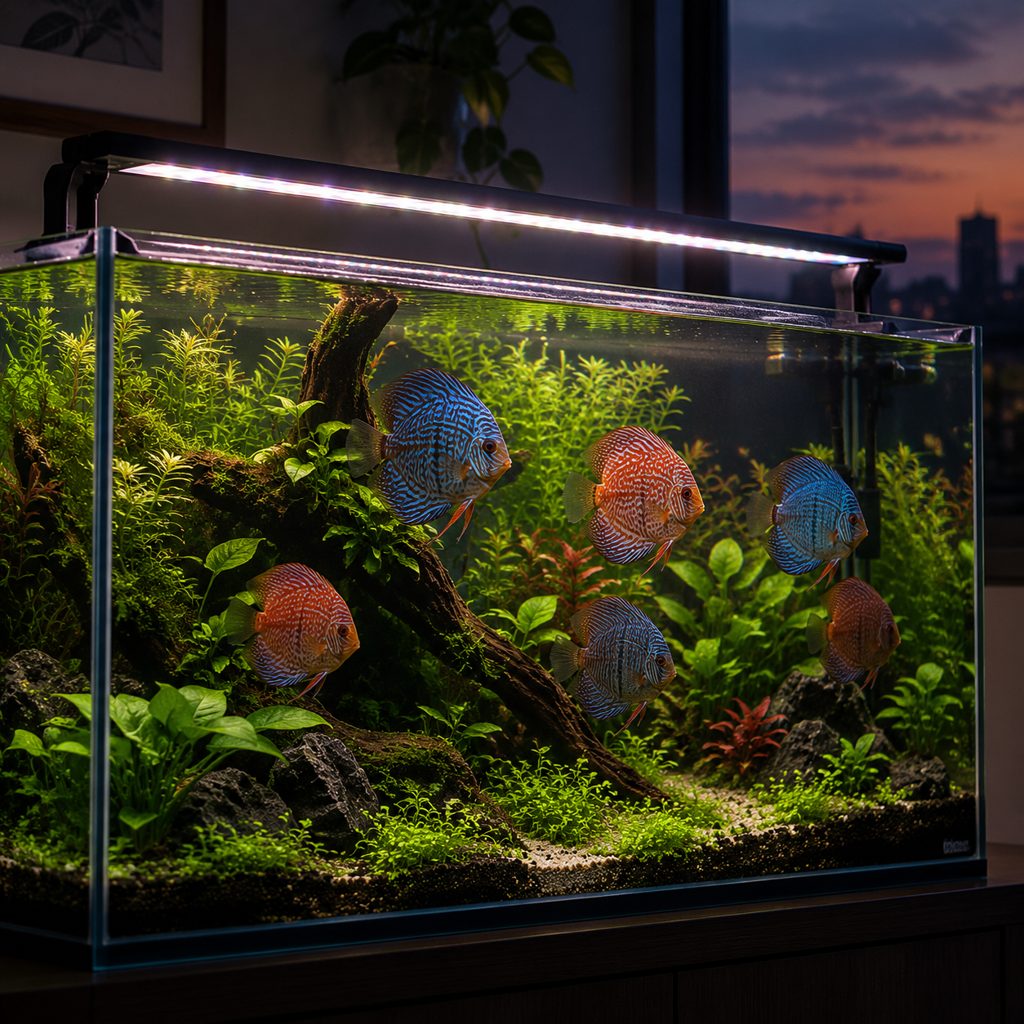
A discus aquarium has to work as a habitat and as a display in your home. The brightest light is not automatically the best choice, and an elaborate aquascape is only enjoyable if you can keep it clean. Start with a reliable day-and-night rhythm, then adjust the intensity and layout while watching how the fish use the space.
Set a consistent photoperiod
For display LED lighting, 6–8 hours a day is a standard starting schedule. Longer illumination is not inherently better. A timer makes the daily pattern predictable and prevents accidental all-day lighting. Choose a window that fits when you want to view the aquarium, then keep the same on and off times. U.S. product listings use terms such as “planted aquarium LED lighting,” “24/7 aquarium LED,” and clip-on lights, with features like sunrise, daylight, and moonlight modes. Those are product categories and listing language, not evidence of a U.S. consensus on the ideal schedule or intensity for discus.
Soften the light and observe behavior
Strong light can unsettle discus. A dimmable LED lets you start below full output, while a gradual sunrise setting can avoid an abrupt transition from darkness to full brightness. Driftwood or floating plants can soften the beam and create shaded areas where fish can retreat. Keep the contrast moderate; a stark bright patch beside a very dark corner may make fish wary rather than secure.
Begin with subdued lighting and observe over time. If the fish remain crowded in a corner or unusually still, reconsider intensity and layout. Check breathing and feeding behavior as well. Dull-looking color by itself does not prove that the light is causing stress: background color and illumination also change how color appears to a person. Make one adjustment at a time so you can tell what changes the fish respond to.
U.S. online listings provide a range of equipment styles and price points. On October 12, 2026, an Amazon listing for a 22-watt Fluval Plant 3.0 LED showed $149.99, while an 18-watt hygger LED listing with sunrise/daylight/moonlight wording showed $37.04. These are examples from marketplace listings at retrieval, not stable prices or recommendations for every tank. Match a fixture to the aquarium’s dimensions and the light level you actually need; a product described for planted tanks may be more output than a fish-focused display requires.
Choose a layout you can keep clean
| Feature | Display-focused setup | Maintenance-focused setup |
|---|---|---|
| Main elements | Driftwood and plants for a natural look | Bare-bottom or near-bare arrangement |
| Cleaning | More work around furnishings | Easier to see and remove waste |
| Water-quality upkeep | More demanding | Simpler to monitor and maintain |
| Helping fish settle | Plants and wood can provide hiding places | Add shade or visual dividers thoughtfully |
A bare-bottom setup is a practical option when easy cleaning and water-quality management are the priority. A furnished display can provide visual interest and places to retreat, but substrate and wood require maintenance around and beneath them. The sources reviewed for U.S. market examples do not establish which layout discus keepers generally prefer. Choose based on your own maintenance routine and what you want the aquarium to do, rather than assuming one setup is the local norm. Our article on substrate and driftwood examines those tradeoffs in more detail.
Do not feel pressured to complete a complex layout on day one. Start with an arrangement that leaves room for cleaning, watch where the fish rest and swim, then make changes. Place driftwood so you can still reach the bottom with a siphon. If plants or floating cover create shade, ensure you can maintain them without repeatedly disturbing the fish.
Backgrounds affect the way color reads
A darker background can make body color look more defined; a lighter one can give the fish a softer appearance. That is a visual effect, not necessarily a change in the fish itself. When comparing color over time, try to keep lighting and background conditions consistent. Adjust the fixture and backdrop together so the fish remains easy to see without using harsh illumination.
FAQ
Can I leave the aquarium light on all day?
Use a timer for a consistent 6–8-hour photoperiod rather than leaving the display light on continuously. A predictable dark period is part of the daily routine.
What should I try if the light seems too strong?
Lower the output, add gradual ramping if available, or soften the beam with driftwood or floating plants. Watch behavior and breathing, not color alone.
Is a planted display or a bare tank better for discus?
Neither is universally best. A bare-bottom setup is easier to clean; a planted or wooded display takes more maintenance but offers a natural look and cover. Choose the one you can care for consistently.