 The Discus | Discus Fish Care and Breeding Guide
Monte Carlo Aquarium Plant: How to Grow a Foreground Carpet
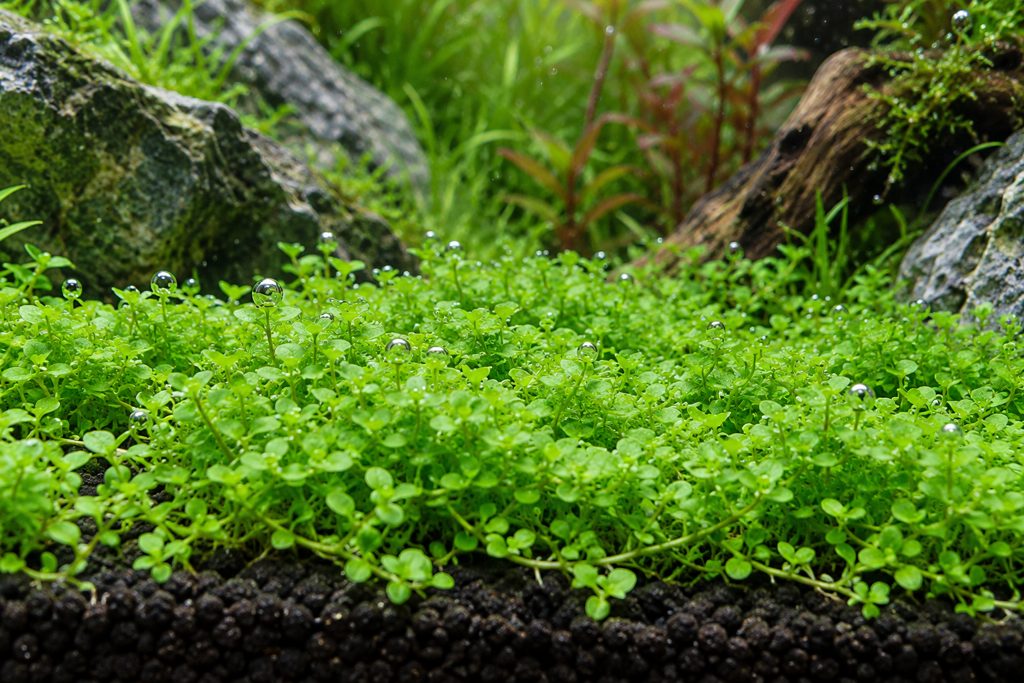
Monte Carlo (Micranthemum tweediei), usually sold simply as “Monte Carlo,” is a small-leaved foreground plant that spreads sideways on runners. With time, connected growth can cover the substrate in a green carpet. It is often presented as an approachable alternative to dwarf baby tears, but a carpet still takes planning: light, nutrients, time, and trimming all shape the result.
You do not necessarily need the most demanding equipment to keep it alive. In a lower-tech tank it may spread gradually, but a reliable, dense carpet is not guaranteed without stronger light or added CO₂. Aquarium Co-Op recommends medium-to-high light (20–50+ PAR) and describes CO₂ as optional but preferred. That is a more demanding target than assuming every low-tech setup will carpet successfully.
Plant small starts and let the runners fill in
Divide a portion into small clumps and use tweezers to plant each one into the substrate. Keep the leaves above the surface and leave visible gaps between starts. A few spaced clumps have room to send runners across open ground, and you can adjust their position as you see which areas fill first. Planting a solid mat immediately can make it harder to spot poor growth or remove dead material beneath it.
| Feature | What to expect |
|---|---|
| Leaves | Small and rounded |
| Growth | Creeps outward on runners |
| Planting | Divide into small clumps and space them apart |
| Light | Medium light can work; stronger light may support faster carpet growth |
| CO₂ | Optional but preferred in Aquarium Co-Op guidance |
| Substrate | Nutrient-rich substrate can encourage faster spread |
Nutrient-rich substrate tends to support faster spread, but growth rate also depends on the full setup. Aquarium Co-Op uses familiar planted-tank terms such as “carpeting plant,” “runners,” “melting,” and “root tabs.” If planted starts melt after introduction, check that they are anchored and look at the tank’s light and nutrient conditions rather than assuming the species is simply unsuitable. Root tabs are one possible tool where the substrate needs additional nutrients.
Keep the carpet low with regular trimming
Monte Carlo can become thick and lift upward instead of staying close to the substrate. Trim taller growth back in stages, keeping enough healthy plant below the cut to maintain coverage. Avoid removing a huge section at once; work across the carpet in smaller areas and clear clippings so they do not decay in the aquarium.
In stronger light, small oxygen bubbles may collect on the leaves. It can be a pleasing aquascape detail, but bubbles alone do not prove that the carpet is healthy. Judge the plant by steady new growth, rooted runners, and the condition of the leaves. If you want to compare a different foreground option, see our article on dwarf baby tears.
Buying Monte Carlo in the United States
Search for “Monte Carlo aquarium plant” and check that the listing identifies Micranthemum tweediei where a scientific name is provided. Aquarium Co-Op and Canton Aquatics are verified online buying options in the listings reviewed. Canton Aquatics’ plant was also represented through a Walmart marketplace listing. This is a niche live plant: compare the portion format, shipping terms, and condition on arrival, not just the product title.
The listed prices are not directly equivalent because portions differ. Aquarium Co-Op listed Monte Carlo at $7.99. Canton Aquatics listed a 4-ounce portion cup at $9.73 and a 2-inch pot at $13.31. Those are individual listing prices, not a US-wide average. A larger-looking portion can be the better choice for a quick start, but small clumps can be divided and planted with space to spread if you can wait.
No species-specific US federal or state restriction or CITES status was confirmed in the market lookup, and state-by-state live-plant shipping rules were not reviewed. Do not treat any one retailer listing as confirmation that shipping or sale is unrestricted everywhere.
Common questions
Does Monte Carlo need CO₂?
CO₂ is described as optional but preferred in Aquarium Co-Op’s care guidance. Some lower-equipment tanks may support gradual growth, but dependable carpeting without CO₂ or strong light has not been established by the seller listings. Match expectations to the equipment you have and be prepared to wait.
How do I keep Monte Carlo from growing too tall?
Trim it back in stages when the mat thickens or begins to rise. Leave rooted, healthy growth behind and remove cuttings from the tank so the foreground remains low and open.
How long until it covers the substrate?
There is no single timeline. The rate depends on light, substrate nutrients, CO₂, and plant condition. Space the starts, watch runner growth, and let the carpet fill gradually rather than expecting a finished foreground immediately.
‹ Back to all articles