 The Discus | Discus Fish Care and Breeding Guide
How to Grow Dwarf Sagittaria in a Freshwater Aquarium
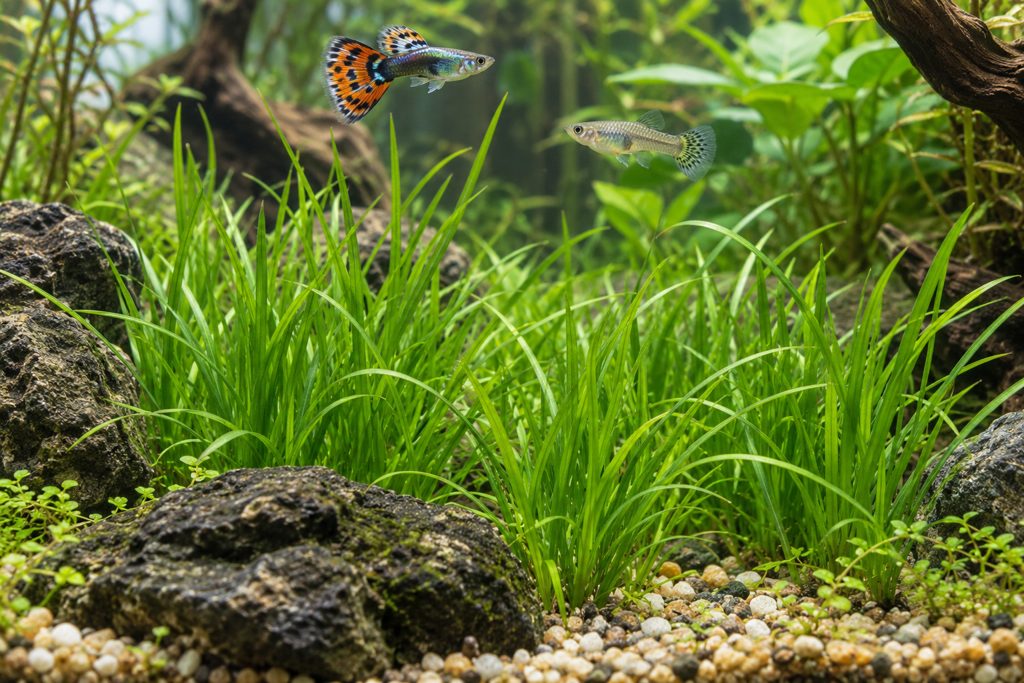
Dwarf Sagittaria is a practical choice when you want a grassy foreground without turning the aquarium into a high-tech project. In US shops it is usually sold as Dwarf Sagittaria, dwarf sag, or Narrowleaf Sagittaria; Aquarium Co-Op identifies it as Sagittaria subulata. Its narrow leaves rise from small crowns, while runners send new plantlets across the substrate. Given time, a few well-spaced starts can become a loose meadow.
That growth habit is the main appeal—and the reason to plan its placement. This is not a plant that stays exactly where you put the first bunch. It can fill open ground, but it can also cross a boundary or crowd a slower foreground plant if you never thin it.
Decide where it belongs by looking at the light
The name “dwarf” does not guarantee a uniformly short carpet. In lower light, leaves tend to stretch upward; plants can exceed 7.9 inches (20 cm). That may be useful in a midground or background, but a tall clump can hide fish and smaller plants when you expected a neat foreground. Stronger light tends to keep the growth shorter, though the result still depends on the aquarium.
| Setup | Likely look | Placement idea |
|---|---|---|
| Lower light | Taller, more upright leaves | Midground or toward the back |
| Stronger light | Easier to keep relatively low | Foreground planting |
| No added CO₂ | A reasonable starting point | Plant a small patch and observe |
Aquarium Co-Op describes its dwarf sag as an easy, runner-spreading plant that does not require CO₂, and recommends medium light (20–35 PAR) and root tabs. Aquatic Arts describes its Narrowleaf Sagittaria as suited to moderate-to-high light, also without required CO₂. Those listings are useful starting points, not a promise that every tank will produce the same height or growth rate. If your substrate is inert, root tabs are one shop-recommended way to provide nutrition near the roots.
Plant crowns with room to travel
Separate the runners into individual rooted starts if you have them, then plant each crown in the substrate with its leaves above the surface. Leave gaps rather than covering the entire foreground on day one. The open spaces make it easier to see which direction the runners are moving and let you adjust the layout before the patch gets dense.
When new plantlets appear, keep the ones that help the shape you want and remove or replant the rest. Trim leaves that have grown too tall, or move the clump farther back if you want to retain its height. Thin a crowded patch at the edges so it does not swallow neighboring plants or block a clear strip of substrate. A slightly irregular meadow often looks more natural than a perfectly even lawn.
Buying dwarf sag in the United States
Search the common names rather than relying on a bare “Sagittaria” label, and check the listing’s botanical name when possible. Aquarium Co-Op, Aquatic Arts, and AquariumPlants.com are verified online plant-shop options in the listings reviewed for this guide. Aquarium Co-Op states that it does not ship this live plant to Alaska or Hawaii, so check the seller’s current delivery terms before ordering. Retail listings are not a complete state-by-state review of plant rules; do not treat a product page as proof that every route or location has identical requirements.
Prices vary by portion and seller. Aquarium Co-Op listed a pot at $7.99 in October 2026. Aquatic Arts listed a bunch for $5.99, two for $8.99, or three for $11.99. AquariumPlants.com listed a 20-plant grouping for $22. These are individual retailer prices captured in October 2026, not a nationwide average; compare portion size, shipping, and the number of usable crowns before deciding which is the better value.
Common questions
Can dwarf Sagittaria grow without injected CO₂?
Yes, it is sold as a plant that does not require added CO₂. Growth can be slower or the leaves taller in a modest setup, so start with a small section and judge it under your actual light and substrate.
Why is my foreground plant getting tall?
Lower light commonly encourages taller leaves, and dwarf sag can grow beyond 7.9 inches (20 cm). Move it toward the midground, improve light reaching the planting area, or thin and trim the patch to preserve sightlines.
Will it take over the whole aquarium?
It spreads by runners, so it can expand beyond its original footprint. Remove unwanted plantlets and keep a defined edge; you do not need to wait for the entire substrate to fill before shaping the patch.
‹ Back to all articles