 The Discus | Discus Fish Care and Breeding Guide
RO/DI Water for Discus: Setup, Blending & Costs
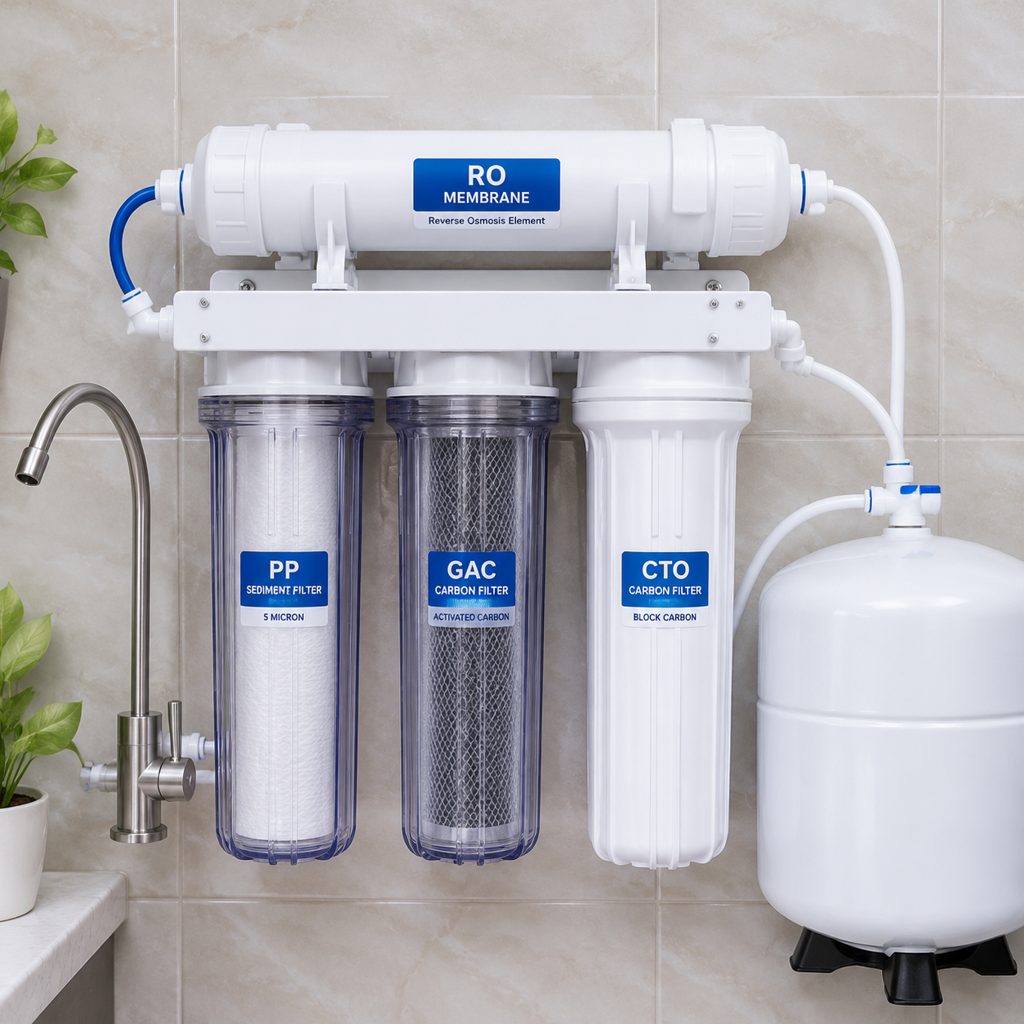
Reverse osmosis can help when your tap water is hard, when you are preparing to breed discus, or when you are keeping a fish that needs water different from your local supply. It is not a required first purchase for every discus aquarium. Many keepers can begin with dechlorinated tap water and consistent water changes, then decide whether their measured water chemistry calls for more control.
What an RO/DI system does—and does not do
A reverse-osmosis membrane removes much of the dissolved material in source water. Home units commonly pair the membrane with prefilters such as activated carbon. RO water can have a total dissolved solids reading (TDS) close to zero, but it also contains very little mineral content and buffering capacity. Do not pour it straight into a discus tank without adjusting it. Blend it with suitable tap water or a known mineral product, then test the finished water.
U.S. shopping pages use labels such as RO, RO/DI, or RODI, and describe the number of filtration stages, rated GPD capacity, and TDS-related output claims. Some listings include booster pumps, membrane-flushing features, or DI resin. A rated capacity and an advertised output claim do not tell you whether the resulting water chemistry fits your fish or your municipality's tap water. Check the product specifications and test the water you actually make.
When is RO water worth considering?
It can be useful for breeding, for sensitive wild or Heckel-type fish, or when your tap water is much harder than the general discus reference of GH 1–5°dH. Measure first; do not buy equipment based only on another aquarist's recipe. Captive-bred discus may do well with dechlorinated tap water, depending on the fish and the source water. Keep notes on the aquarium's existing pH, GH, KH, and TDS before changing your routine.
Blend by chemistry, not by one TDS number
The care reference gives TDS ranges of 100–200 ppm for routine grow-out and 50–100 ppm for breeding. These are guides rather than universal targets. TDS does not reveal the exact minerals or carbonate hardness (KH), which contributes to buffering. Two water samples with the same TDS can differ in GH and KH.
Test the tap water and RO water separately for TDS, GH, and KH. Mix a small trial batch in a clean container, measure all three values again, and adjust until the blend suits the fish and remains stable. If the TDS falls into the intended range but GH or KH does not, revise the ratio or use a mineral product whose composition you understand. Record the source-water measurements and final ratio so you can repeat it.
As a first estimate, if tap water has TDS D, RO water is close to zero, and the desired TDS is T, the tap-water portion of a final volume V is approximately V × T ÷ D. Fill the rest with RO water. For example, reducing 200-ppm tap water to 100 ppm starts with equal parts tap and RO. Treat that as a trial calculation, not the finished recipe: measure TDS, GH, and KH in the actual blend before use.
Costs, waste water, and upkeep
An RO system sends some water to drain. The care guide estimates two to four liters of wastewater for each liter of product water, roughly a 1:3 product-to-waste ratio. Account for that when choosing a location and planning how much water you need. Many basic home units run on household water pressure rather than an electrical supply, but designs differ; check the unit's requirements, especially if it includes a booster pump or storage features.
U.S. listing snapshots from October 2026 showed an Aquatic Life RO Buddie four-stage, 50-GPD unit at $69.99 and a Bulk Reef Supply four-stage Value Plus, 75-GPD unit at $249.99. Those are examples from online listings, not a market-wide price range or a recommendation. Compare included cartridges, replacement costs, fittings, and the system's stated operating conditions before purchase. Amazon.com was a verified online channel in this research pass; no independent retailer comparison or regional tap-water comparison was established.
The RO membrane is a consumable; a general replacement reference is every one to two years, depending on use and water conditions. Follow the manufacturer's schedule for prefilters as well. Periodically test the RO output: a rising TDS reading can be a prompt to inspect the membrane and cartridges, but use the system's instructions to decide what to replace.
FAQ
Can I use 100% RO water in a discus tank?
Not without restoring the necessary mineral content and buffering. Blend with appropriate tap water or remineralize with a product you understand, and verify GH and KH as well as TDS before using it.
Do RO/DI units need electricity?
Many basic units use household water pressure, while some listed designs include booster pumps or other features. Check the specific unit's requirements rather than assuming every system is powered the same way.
Should a new discus keeper buy RO/DI first?
Usually, start by testing dechlorinated tap water and maintaining regular water changes. Consider RO when measured chemistry, breeding goals, or the needs of a particular fish justify the extra setup and water preparation.
‹ Back to all articles