 The Discus | Discus Fish Care and Breeding Guide
Discus Breeding Problems: Eggs, Hatching, and Fry
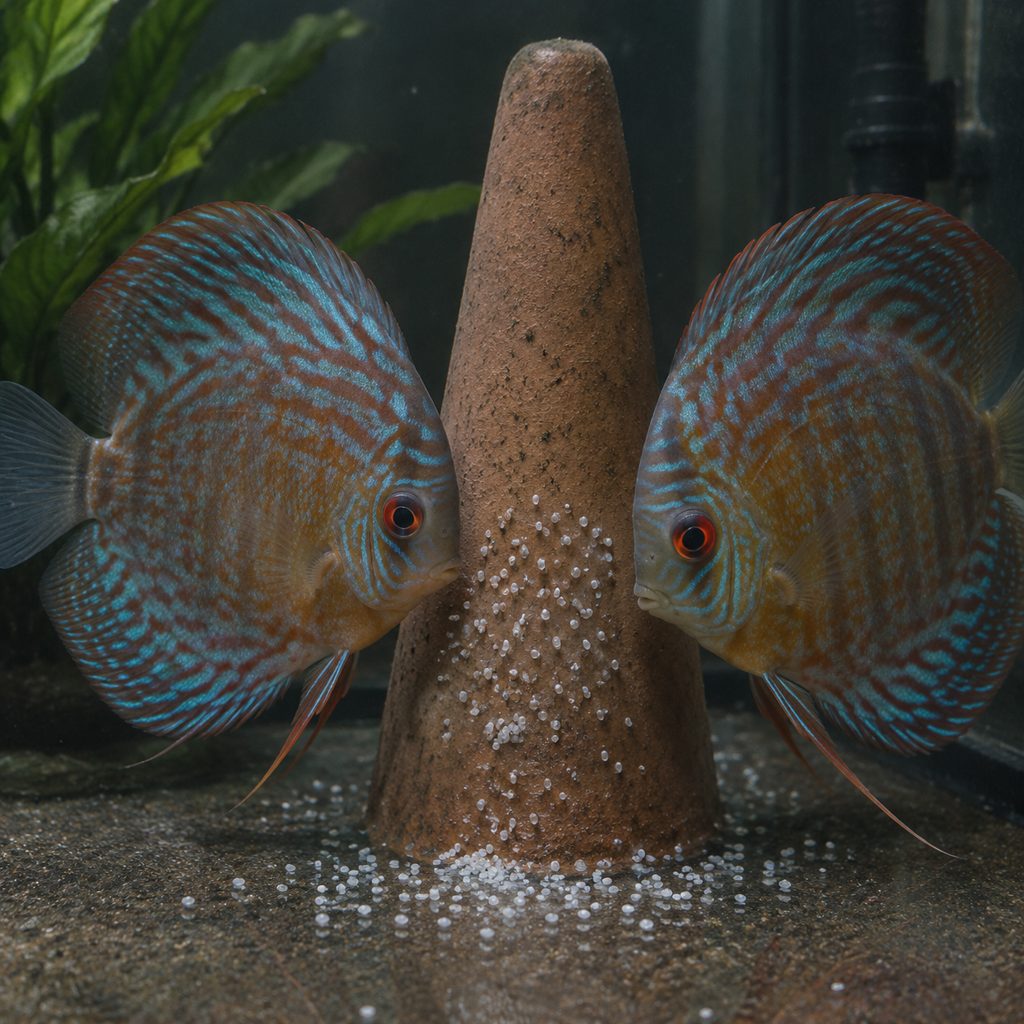
A clutch disappearing or turning white is discouraging, but one failed spawn does not tell you whether a pair can become reliable parents. Watch the eggs, the adults, and the water together. Write down what happens before changing several things at once; a calm record is more useful than guessing from one bad outcome.
A quick guide to common setbacks
| What you see | Possible explanation | First response |
|---|---|---|
| Adults eat the eggs | Inexperience, disturbance, stress | Reduce activity around the tank and observe later spawns |
| Eggs turn opaque white | Unfertilized eggs or fungus | Watch for development and remove clearly fungused eggs carefully |
| Eggs do not hatch | Temperature swings or changing water conditions | Check the heater, thermometer, and water-change routine |
| Parents eat free-swimming fry | Stress or poor adult condition | Assess the parents and consider early separation if needed |
When the parents eat a clutch
Young pairs may eat eggs during their first few spawns. They may still be learning to fertilize and fan the eggs, and footsteps, vibration, or abrupt changes in water can add stress. If the fish are otherwise healthy, give them room and observe the next attempts rather than immediately removing every clutch. Some pairs become steadier after three or four spawns, though there is no guarantee.
If egg eating continues, first confirm that eggs are being fertilized and that the adults are fanning them. A mesh guard or purpose-made cover can protect eggs while allowing water movement. Moving a clutch to a separate hatching setup is another option, but it transfers the work of caring for eggs and newly hatched fry to you. Intervene sooner if an adult is clearly unwell or the same problem keeps recurring.
White eggs are a clue, not a diagnosis
Developing fertilized eggs may take on a pale brown tint. Eggs that remain opaque white and show no development may be unfertilized. Fungus can look like cotton on an egg and may spread to nearby eggs. A brief observation can help distinguish a developing clutch from eggs that are deteriorating; appearance alone is not always conclusive.
Remove clearly fungused eggs with a pipette or similar tool, taking care not to damage healthy ones. If most of a clutch turns white, review both the pair’s maturity and water conditions. Soft, slightly acidic breeding water is one approach: pH 5.0–6.5 and TDS 50–100 ppm, alongside GH checks. TDS meters use different ppm conversion scales, so compare readings with the same meter and setting, and measure GH and KH rather than relying on TDS alone. These are reference targets, not a verified US-wide recipe.
Give eggs a stable hatch environment
At a steady 82–86°F (28–30°C), eggs generally hatch in about two to three days. Check for overnight temperature drops and sudden water changes. Use a reliable heater and thermostat, and match replacement water to the tank’s temperature and chemistry. Avoid suddenly increasing the amount of water changed after spawning. Keep noise and vibration around the aquarium low.
In US aquarium shops, spawning equipment is commonly called a “spawning cone” or “breeding cone.” Cones made of ceramic or pottery clay give eggs an attachment surface; spawning slates and breeding caves also appear in listings. An Amazon search retrieved in October 2026 showed individual listings for a Saim ceramic cone with net at $16.99, an AQUA KT terracotta cone at $19.99, and a JBL DisCon cone at $30.35. These are listing examples, not a market-wide price range or a guarantee that one design suits every setup. Place the cone before the pair spawns so introducing it does not disturb the clutch.
Fry care and the point to step in
Newly hatched discus fry initially feed from mucus on their parents’ skin, often called discus milk. An adult that is stressed or in poor condition may eat fry before they begin swimming freely. If the parents are settled, observe before intervening. If a parent’s condition is clearly deteriorating, early separation or artificial hatching may be appropriate. Artificial hatching means managing eggs with aeration and then raising the fry without parental care; it is not a low-effort shortcut.
Discus.com, a US-facing specialty shop, lists “breeding pairs” as a product category and says it breeds some fish as well as receiving overseas shipments. The category confirms the term is used in US retail, but the listing alone cannot establish that a pair is proven, bonded, or compatible. Ask a seller exactly what “pair” means before buying fish for a breeding project.
Before the next spawn, check the heater and water tests, prepare temperature-matched replacement water, and make sure the adults are in good condition. A simple log of spawn date, temperature, pH, TDS, egg color, and parental behavior can reveal a repeated pattern.
Common questions
Are egg-eating parents unsuitable breeders?
Not necessarily. Some pairs improve with experience. Observe several attempts—three or four spawns can provide more context—before deciding, unless the fish’s condition calls for earlier action.
Does a white clutch mean the male is infertile?
It can point to unfertilized eggs, but water chemistry and other factors also matter. Assess egg development, both adults, and GH, KH, and pH.
When should I switch to artificial hatching?
Consider it when egg eating repeatedly continues or a parent is clearly unwell. Otherwise, leaving settled parents to care for the clutch may be the better first choice.
Our article on preparing RO water for discus breeding explains how to track the chemistry of a breeding setup.
‹ Back to all articles