 The Discus | Discus Fish Care and Breeding Guide
How to Prepare RO Water for Discus Breeding
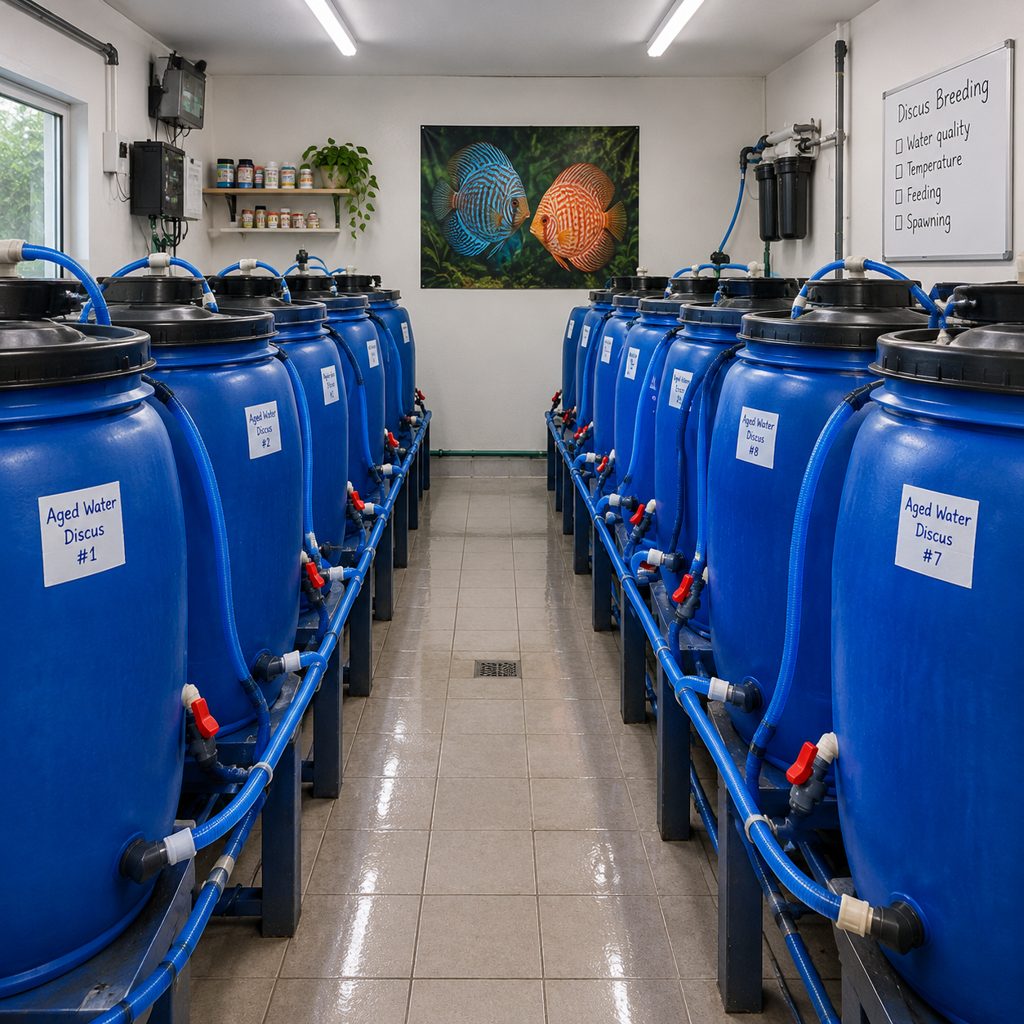
Breeding discus often means making water softer and more predictable than the water coming from your tap. The goal is not to copy a number from someone else’s aquarium. Start by testing your own source water, then make gradual adjustments and keep records. Tap-water chemistry varies across the United States, and there is no single RO-to-tap recipe that fits every home.
Breeding targets—and what they do and don’t tell you
For routine discus care, a useful reference range is 82–86°F (28–30°C), pH 6.0–7.0, and GH 1–5°dH. Breeding and wild-type fish are sometimes kept at softer, more acidic values: pH 5.0–6.5 and TDS 50–100 ppm. For grow-out, the reference TDS range is 100–200 ppm. These are care targets, not a verified US breeder consensus or a guarantee that a pair will spawn.
| Measurement | Routine care / grow-out reference | Breeding reference |
|---|---|---|
| Temperature | 82–86°F (28–30°C) | 82–86°F (28–30°C) |
| pH | 6.0–7.0 | 5.0–6.5 |
| GH | 1–5°dH | 1–5°dH, toward the lower end |
| TDS | 100–200 ppm | 50–100 ppm |
A TDS meter estimates dissolved solids; its ppm display depends on the meter’s conversion scale. Check the setting and use the same meter and scale when comparing readings. If your meter reports electrical conductivity, recording µS/cm can also help you follow changes consistently. Don’t treat a single TDS reading as a substitute for GH, KH, and pH tests.
Start with the water you have
Reverse osmosis (RO) water has passed through a membrane that removes most minerals and impurities. Its TDS may fall to a few ppm up to about 20 ppm, making it a useful starting point for soft water. But RO water alone has little mineral content and buffering capacity; pH can be unstable. Test tap water and RO water separately for TDS, GH, KH, and pH before mixing.
In the US, equipment is commonly listed as “RO” or “RO/DI,” and listings often state production in GPD (gallons per day). An Amazon search retrieved in October 2026 showed an Aquatic Life RO Buddie four-stage, 50-GPD system at $69.99 and a four-stage, 100-GPD RO/DI system at $89.99. Those are individual online listings, not universal prices or a discus-specific endorsement.
A rough starting blend is seven parts RO water to three parts tap water. Treat that as a trial mix, not a formula. Measure the resulting GH, KH, pH, and TDS, then adjust based on your own water. If tap KH is high, adding blackwater products may not bring pH down as expected. Avoid making a large, sudden change to the breeder tank.
Restore minerals deliberately
RO water needs a deliberate mineral plan. Seachem describes Equilibrium as a mineral supplement for RO/DI or other mineral-poor water that raises GH. The manufacturer distinguishes GH from KH, so Equilibrium should not be treated as a KH buffer. An Aquarium Co-Op listing retrieved in October 2026 showed the 1.3-lb size at $17.99. Follow the product label and test the water; don’t assume a GH supplement also solves low buffering capacity.
Blackwater products and peat can add humic substances and tannins, producing a light tea color and tending to lower pH. Add small amounts and observe both the fish and the test results. Darker water can make it harder to inspect fish, and a high KH can limit the effect on pH. Don’t try to force a target pH simply by adding more extract.
Make a repeatable routine
Record each source-water test, the blend, and the finished-water results. During breeding, check TDS daily; for grow-out, once or twice a week is a useful reference schedule. Keep the time of day, meter, and conversion setting consistent. If a reading moves outside your target, retest GH, KH, and pH before changing the recipe. Stability matters more than a dramatic one-time adjustment.
Common questions
Do I need an RO unit?
Not always. If your tap water is already soft and suitable, you may be able to use it with little or no blending. RO is useful when local water is too hard to adjust predictably.
How dark should blackwater be?
Start with a pale tea tint. If it becomes too dark, reduce the dose or dilute through a water change, while watching water chemistry and fish behavior.
How often should I test?
During active breeding, daily TDS checks are a practical reference; for grow-out, one or two checks per week may be enough. Recheck other parameters whenever you change the mix.
Our article on discus breeding failures covers how stable water conditions fit into egg care and hatch management.
‹ Back to all articles