 The Discus | Discus Fish Care and Breeding Guide
Raising Discus Fry: Feeding, Separation, and Water Changes
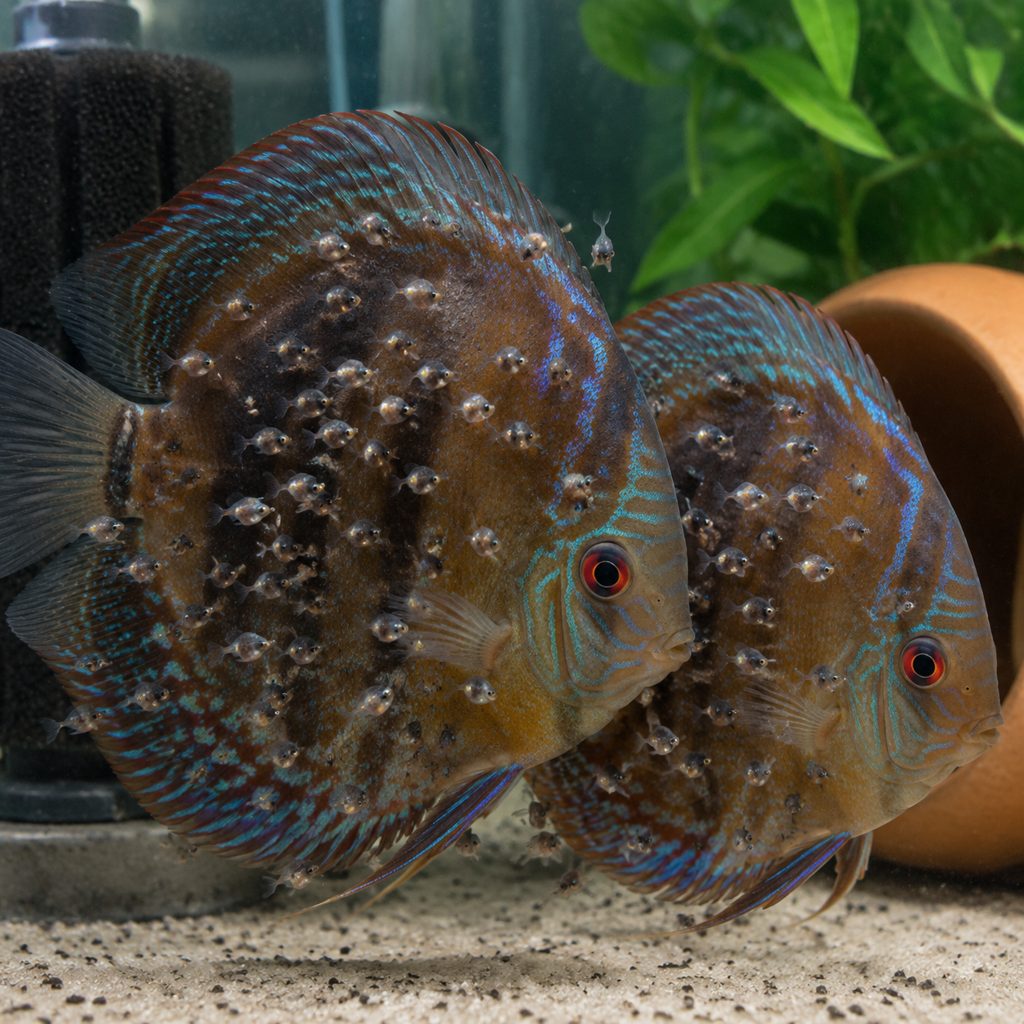
Free-swimming discus fry cluster against their parents and graze on the adults’ skin. It is a remarkable form of parental care, but this stage also means frequent feeding, close observation, and a heavy water-change routine. Have your food and maintenance plan ready before the fry rise; leaving uneaten food in a warm nursery can foul the water quickly.
From hatchling to free-swimming fry
Newly hatched larvae cannot swim. They cling in a group near the spawning surface while absorbing the yolk sac, their first food. Around 3–4 days after hatching, once the yolk is absorbed, they begin swimming together and rise toward the parents. Keepers often call this “free swimming” or “rising.” Before they rise, a parent may pick up a larva in its mouth and move it to another part of the aquarium.
The fry then attach to the adults and feed on mucus secreted from the parents’ skin. Hobbyists call this secretion “discus milk.” It is nutrient-rich, and the young may rely on it for about 2–3 weeks. The parents often take turns carrying and feeding the group. A parent producing skin secretion commonly becomes darker, sometimes nearly black; watch the fish’s overall condition and behavior rather than treating dark color by itself as a problem.
Supplement with newly hatched brine shrimp
Newly hatched brine shrimp, or nauplii, are a useful first supplemental food. Once fry are free swimming, introduce small amounts alongside the parents’ skin secretion. Hatch brine shrimp eggs (often sold as brine shrimp cysts) in saltwater and feed the newly emerged larvae. Offer small portions several times a day. Remove leftovers promptly with a siphon: uneaten food breaks down and can damage water quality.
A U.S. live-food supplier, Brine Shrimp Direct, lists Premium Grade Brine Shrimp Eggs, 8 oz., at $28.95. The same retailer lists a Brine Shrimp Hatchery Dish Starter Kit at $31.25; the kit includes a hatchery dish, brine shrimp eggs, and spirulina powder. Its instructions use the terms “brine shrimp eggs” and “hatchery dish.” These October 2026 listings provide a local buying option and terminology, not a discus-specific product or a confirmed price for baby brine shrimp. Prices can change, and the hatchery dish is for live-food production, not incubating discus eggs.
A specialist online live-food supplier is one verifiable U.S. source for brine shrimp eggs and hatching equipment. Check package size, current price, shipping, and product details before ordering. Product availability establishes where a keeper may buy cysts and equipment; it does not establish a specific feeding protocol for discus fry. The timing below reflects general discus husbandry rather than a locally verified U.S. practice.
Timing separation and water changes
| Fry-care point | General guide |
|---|---|
| Temperature | 82–86°F (28–30°C); stable operation toward the upper end can help growth stay even |
| Start swimming | 3–4 days after hatching |
| Feeding from parents’ skin | About 2–3 weeks |
| Separate from parents | Around 3–4 weeks of age |
| First supplemental food | Newly hatched brine shrimp |
| Water changes | At least 30%, daily to every other day |
Around 3–4 weeks old is a common separation window. Look for fry that willingly leave the adults and gather around supplemental food. Parents beginning to chase them can also signal that separation is due. Treat age as a guide rather than a deadline: separating too early can reduce feeding opportunities and lead to uneven growth. Conversely, if parents are actively attacking fry, respond to the behavior rather than waiting for a particular date.
Frequent meals create more waste than an adult discus tank. Plan water changes of at least 30% every day or every other day. Match replacement water to the aquarium’s temperature, and avoid sudden water-quality or EC/TDS changes. Watch how quickly the tank accumulates waste and adjust maintenance accordingly. If the fry begin to vary widely in size, periodically sort them by size to help keep groups more uniform.
If one parent ignores the fry, that can be manageable; sometimes one adult does most or all of the care. If the other parent is chasing them, separate that fish and allow the attentive parent to continue. If parents eat fry, consider stress, disturbance, and whether the environment needs to be changed. The priority is a calm, stable setting with close observation.
A simple routine after the fry rise
Keep the water between 82 and 86°F (28–30°C) and watch the temperature closely, especially if maintaining it toward the upper end. Once the fry swim, offer newly hatched brine shrimp in small portions several times daily while they continue to feed from their parents. Siphon uneaten food after meals. Complete at least a 30% water change daily or every other day, using water that matches the tank’s temperature and does not cause an abrupt shift in chemistry.
Continue watching both the adults and young. At about 2–3 weeks, the fry may still be attached to the parents for meals. Around weeks 3–4, look at feeding behavior and parental response to decide whether to separate them. Gradually transition them toward prepared foods as they grow. For the earlier stages, see our article on eggs to hatch; the hatch itself is only the beginning of feeding and rearing.
Questions about raising discus fry
One parent is not caring for the fry. Is that normal?
It can happen. One adult may take on most or all of the care. If the other fish chases the fry, separate the aggressor and let the attentive parent raise them alone.
Can fry grow on discus milk alone?
They can grow to some extent on the parents’ skin secretion, but adding newly hatched brine shrimp once they begin swimming helps them learn to accept food. Offer it alongside parental feeding rather than treating it as a replacement from day one.
Is it harmful to separate fry too early?
It can reduce feeding opportunities and make growth uneven. Around 3–4 weeks is a guide; check whether fry are feeding independently and whether the adults are still caring for them before moving them.
‹ Back to all articles