 The Discus | Discus Fish Care and Breeding Guide
Sunset and Butterfly Discus: Warm Color and Care Guide
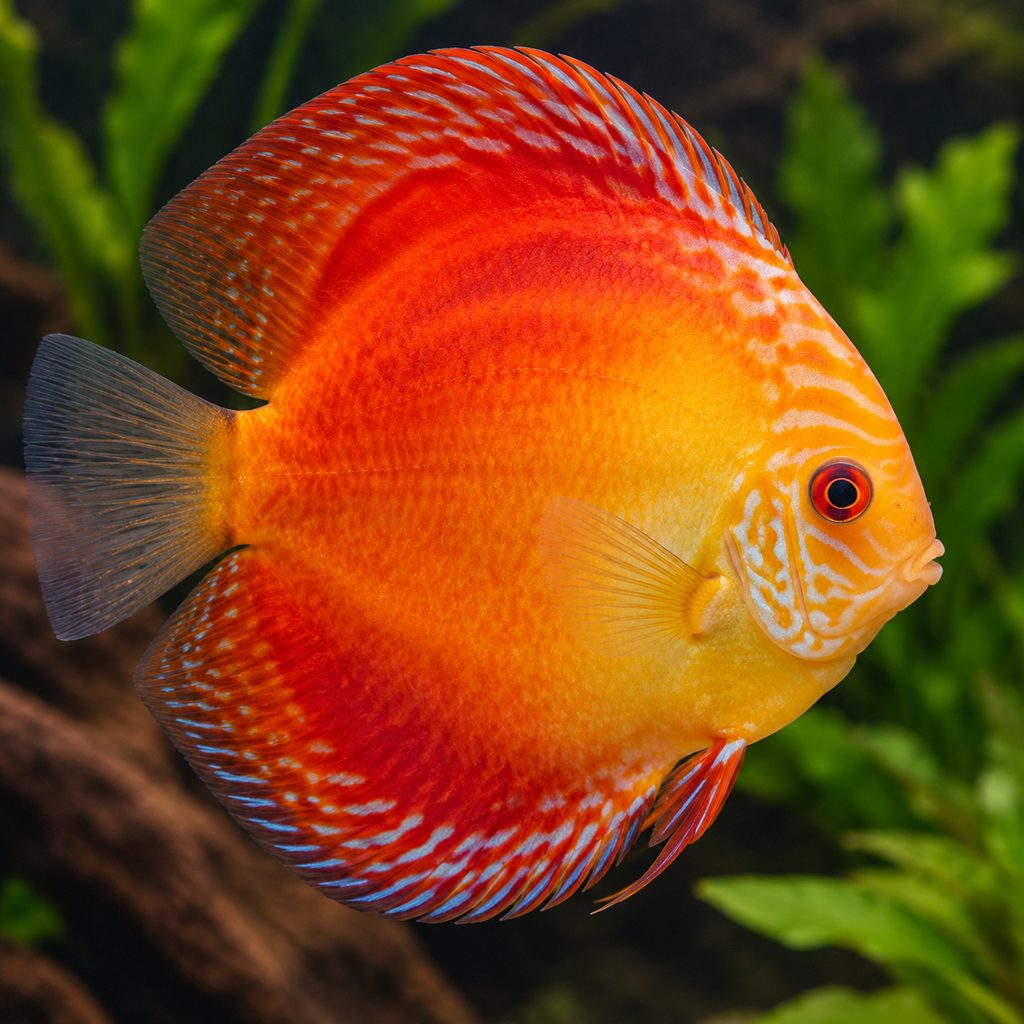
Red and yellow discus make a very different statement from the familiar blue strains. Sunset and Butterfly are warm-color names that describe related palettes but different visual goals. Sunset fish are selected for blended color, while Butterfly fish draw the eye with stronger divisions and patches. In either case, choose the individual fish you like and check its health first; a strain name is not a promise that every fish will match a catalog image.
Sunset: a gradual shift from red to gold
Sunset discus carry warm tones that may transition from red through orange to yellow. Some fish show a clear difference between the head and tail, while others have a more even wash across the body. Lighting and viewing angle change how those colors read, so inspect the fish under calm, ordinary aquarium lighting rather than judging a single bright photo.
The attraction is the transition itself. When shopping, decide whether you prefer a strong gradient or a more uniform field. Keep in mind that individual markings and intensity vary, and the eventual look may shift as a young fish grows.
Butterfly: contrast and distinctive markings
Butterfly discus use a similar red-to-yellow base, but their patches and color boundaries are the focus. The distribution of markings can suggest a butterfly’s open wings. Each fish has its own pattern, and young fish may not yet show a crisp division between red and yellow. Part of the pleasure is watching those areas become more distinct with growth.
Neither name is a substitute for asking about the fish itself. Request current photos, size, feeding history, and information about the parents or line if the seller has it. Look for a round, deep body, relatively small eyes, unbroken dorsal and anal fins, and an alert response to food. A bright fish that is thin, breathing hard, or ignoring food deserves more scrutiny than one whose color is still developing.
Buying in the United States: names and prices need context
A specialist online retailer’s U.S. hybrid-discus category is a verifiable place to compare cultivated discus listings. The page includes “German Red Turquoise Discus, Red Base” and “German Red Turquoise Discus, Blue Base,” each shown at $44–$159. Those are the retailer’s named German Red Turquoise variants, not verified Sunset or Butterfly fish, and those prices should not be used as a price estimate for either strain. The listing is useful as an example of local retail naming and of a buying channel, not proof that every named warm-color strain is available.
The category checked did not show a listing explicitly called Sunset or Butterfly, so U.S. availability under those exact names remains unconfirmed. No specific U.S. price anchor for Sunset or Butterfly was found. Ask retailers how they identify their fish, whether the name refers to a line or an individual pattern, and what the quoted price includes. No strain-specific legal status was verified for this guide; check applicable local rules rather than assuming a listing settles that question.
Food and water support the color you already have
Genetics set the starting point for red and yellow coloration. A quality prepared discus food can be the staple, with frozen bloodworms or brine shrimp as additions. Check ingredient and nutrient labels when choosing a color-supporting food: some formulations include carotenoids such as astaxanthin for red tones or lutein for yellow. These ingredients support a suitable diet; they cannot turn a fish into a different strain or compensate for poor health.
| Care point | Practical guide |
|---|---|
| Temperature | 82–86°F (28–30°C) |
| pH | 6.0–7.0 |
| GH | 1–5°dH |
| Adult space | About 5.3–6.6 gallons (20–25 L) per fish as a starting guide |
| Water changes | 30–50% once a week for adults |
Keep temperature stable and maintain clean water. A weekly schedule is a starting point for adult fish; feeding, filtration, stocking, and test results should guide maintenance. Do not add extra fish simply by multiplying a per-fish volume. Give discus room to swim and make sure filtration and regular water changes can handle the group.
A calm layout with driftwood and a darker background can make warm tones stand out, provided the fish retain open swimming space. Sunset or Butterfly discus can live with blue strains when their care needs are met; use adequate space and watch for bullying. Healthy condition and consistent husbandry matter more than an exaggerated color promise.
Questions about warm-color discus
Can Sunset or Butterfly discus live with blue discus?
Yes. Their basic temperature and water requirements are alike: 82–86°F (28–30°C) and pH 6.0–7.0. Plan for the whole group’s space and filtration, and monitor behavior after introducing fish.
When will the red and yellow colors become stronger?
Color often develops gradually and approaches its mature appearance around 5.9 inches (15 cm), but individuals differ. Lineage, health, diet, and water quality all play a role.
Does a Butterfly pattern change as the fish grows?
It can. Young fish may have less settled markings, and the red-yellow divisions become clearer in many individuals. Ask for recent images of the specific fish and remember that growth does not guarantee an exact adult pattern.
‹ Back to all articles