 The Discus | Discus Fish Care and Breeding Guide
Royal Blue vs. Wild Discus: Strains, Care, and Prices
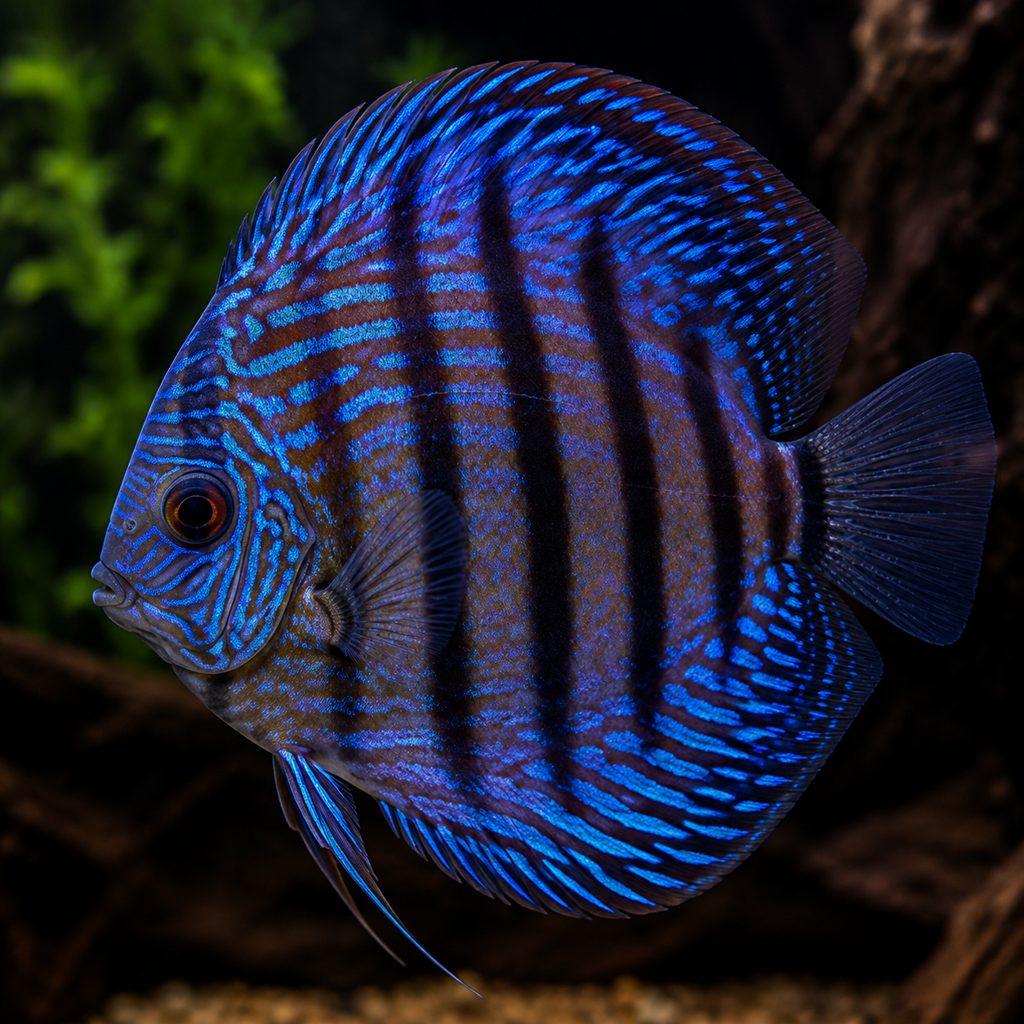
The name Royal Blue can sound like a precise variety, but it is a trade name rather than a formal classification. It may describe fish with a wild-blue look or cultivated lines descended from that look. A wild-caught discus is a different purchase: its collection locality and previous water conditions can matter as much as its color. If you are deciding between the two, ask the seller exactly what the name means for that individual fish.
What “Royal Blue” tells you—and what it doesn’t
Royal Blue discus are associated with blue to blue-green bodies, sometimes with an indigo cast, and prominent vertical bars that run from the dorsal-fin side toward the anal-fin side. Light can bring out a metallic sheen. But pattern alone cannot establish lineage, and sellers may apply the name to different fish. Ask whether the fish is wild-caught or captive-bred, what its parentage is known to be, and how it has been kept.
A cultivated Royal Blue may fit the usual routine for captive-bred discus. A wild fish should not be assumed to tolerate the same water or transition at the same pace. For a broader comparison of captive-bred blue strains, see our article on cobalt and turquoise discus.
Wild types and their different looks
Wild discus come from the Amazon basin, with fish reaching the trade from Brazil, Colombia, and Peru. Their appearance and water history vary by locality and individual.
| Type | Typical appearance | Collection country in the source guide |
|---|---|---|
| Heckel | A broad black vertical bar through the middle of the body; often considered demanding | Brazil |
| Wild brown | Brown ground color with wavy bars; comparatively hardy among wild types | Brazil, Colombia, Peru |
| Wild green | Greenish ground color and reddish bars; often deep-bodied | Peru, Colombia, Brazil |
Retail listings in the U.S. specialist wild-discus category use locality- or strain-style names such as “Wild Classic Brazilian Heckel Discus,” “Wild Manacapuru Blue Discus,” “Wild Monte Alegre Discus,” and “F1 Tefe Red-Spotted Green Discus.” These are the seller’s listing names, not a standardized taxonomy. The F1 label indicates the seller’s naming for a fish associated with a particular line; confirm the parentage rather than assuming every retailer uses labels identically.
Price examples from a U.S. specialist seller
A specialist retailer’s page retrieved in October 2026 displayed Wild Classic Brazilian Heckel Discus at $150–$175 and Wild Manacapuru Blue Discus at $160. It also showed Wild Lago Grande “Blood Red” Discus at $250–$300 and F1 Tefe Red-Spotted Green Discus at $67–$132. Those are individual listing prices, not a U.S. market average. The page did not establish a size-to-price mapping, and prices or options can change. Ask which size and fish are included, whether the listing is in stock, and what shipping costs before ordering.
That retailer states that its fish are held in long-term captivity, quarantined, and acclimated to tap water before shipment. Treat that as the handling approach described by that seller—not a guarantee about all imports, sellers, or individual fish. A specialist online wild-discus inventory is one verifiable buying channel, but a listing does not by itself confirm a fish’s health, history, or suitability for your aquarium. Species-specific U.S. import and state or local restrictions were not verified here; do not infer legal status from retail availability.
Build around the fish’s history
Wild discus often hide and react to changes more readily than established captive-bred fish. Some come from soft, low-total-dissolved-solids (TDS) blackwater, but there is no single water recipe for every locality. Use these ranges as context, then ask for the actual water parameters at the seller’s facility and transition gradually.
| Care consideration | Reference guide |
|---|---|
| Temperature | 82–86°F (28–30°C) |
| pH | 5.0–6.5; 4.5–6.0 when recreating blackwater |
| Water | Soft, low-TDS water where appropriate to the fish’s history |
| Settling-in period | Several weeks to several months |
Keep the new arrival in a separate quarantine aquarium for several weeks. Focus on observation and getting the fish to eat before mixing it with established stock. Gradually match bag and tank temperature and pH; avoid a sudden transfer. Provide subdued light, driftwood or other cover, and a quiet environment. Frozen bloodworms may help a reluctant fish begin feeding; once it eats reliably, gradually offer a quality prepared food. Do not make dramatic chemistry changes simply to match a textbook number.
Questions wild-discus buyers ask
Is Royal Blue always a wild-caught fish?
No. The name is not a strict classification and can refer to cultivated fish with wild-blue ancestry or appearance. Confirm whether the fish is wild-caught, captive-bred, or an F1 from a stated line.
Can I keep a wild discus in ordinary discus water?
It depends on the individual’s origin and holding conditions. The guide range for wild fish is 82–86°F (28–30°C) and pH 5.0–6.5, with lower pH of 4.5–6.0 for a blackwater-style setup. Match the seller’s water first and change conditions slowly.
What should I budget for one?
The October 2026 retailer examples ranged from $67–$132 for its F1 Tefe Red-Spotted Green listing to $250–$300 for its Lago Grande “Blood Red” listing. Other displayed examples were $150–$175 for the Brazilian Heckel and $160 for the Manacapuru Blue. Those prices are seller-specific, not typical market values; verify size, shipping, and current availability.
‹ Back to all articles