 The Discus | Discus Fish Care and Breeding Guide
Cobalt vs. Turquoise Discus: Color, Care, and Buying Tips
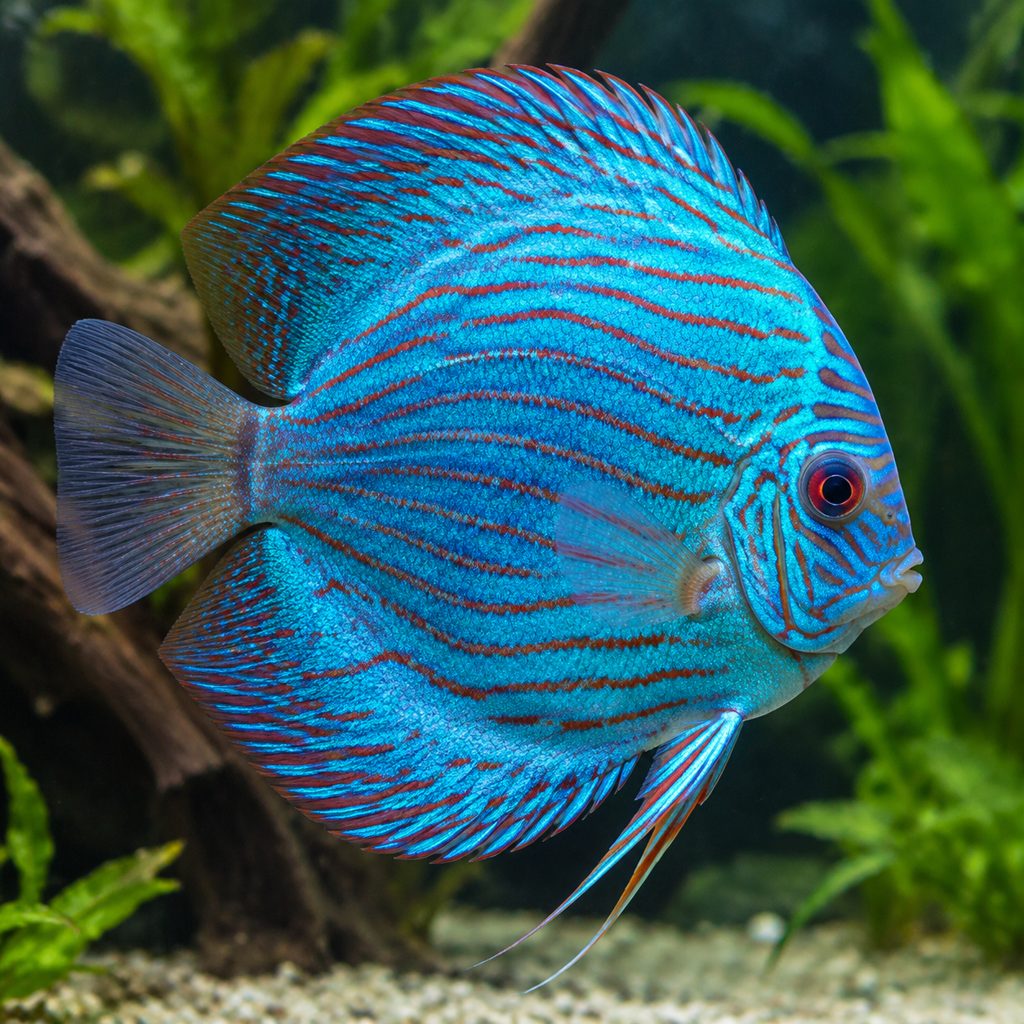
If you are choosing a blue discus, cobalt and turquoise are two names you will run into often. They share a broad breeding history, but the visual goal is different: turquoise is about crisp, repeating lines, while cobalt is prized for a deep, more even blue. In the U.S. trade, sellers may use longer strain names, so look at the fish and ask about its lineage rather than relying on a label alone.
A blue strain with two different looks
Turquoise discus were developed from wild green- and blue-line fish through generations of selection, with breeders favoring the greenish-blue stripes. Cobalt is generally understood as a continuation of that blue-strain work: selection emphasized darker, more uniform blue and reduced the visibility of the bars. They are related points along a breeding continuum, not necessarily two sharply separated categories. Intermediate-looking fish appear, and names can vary by breeder or retailer.
A good turquoise has clear contrast between its ground color and the orderly blue-green markings running from head toward the tail. With cobalt, buyers usually look for a rich cobalt-blue field with little patchiness; the bars may be faint. Individual coloration changes with condition, background, and lighting, so judge a fish after it has settled rather than through a shipping bag under harsh lights.
What U.S. listings can—and cannot—tell you
A specialist U.S. online retailer provides a dedicated hybrid-discus category. Its listing names include “Cobalt Discus With Deep Blue Gene,” shown at $48–$163, and “German Red Turquoise Discus, Red Base” and “German Red Turquoise Discus, Blue Base,” each shown at $44–$159. “High Bodied Blue Tiger Turquoise Discus” is listed at $40–$182. These are displayed listing ranges from a retailer page retrieved in October 2026, not typical U.S. prices or a guarantee that a particular fish is in stock. The page does not map a price to fish size or state shipping costs, so confirm both before ordering.
Those names also illustrate why “turquoise” does not always mean one simple pattern, and why the retailer’s wording should not be treated as a formal classification. Ask for recent photos or video, the fish’s current size, what it eats, and how long it has been in the seller’s system. No strain-specific legal status was verified for this guide; do not infer restrictions—or their absence—from a product listing. Check applicable rules for your location when needed.
Select a healthy fish, not just a vivid one
Look for a rounded, deep body without a pinched belly, eyes that appear small in proportion to the body, and intact, extended dorsal and anal fins. The fish should breathe without obvious strain and respond to food. For turquoise, inspect the regularity and contrast of the bars; for cobalt, look for evenness of color. A stressed discus may darken or hide, so observe it long enough to see its normal behavior. If possible, ask the seller to feed the group.
Set up for stable color and health
| Care point | Working range or guide |
|---|---|
| Temperature | 82–86°F (28–30°C); steady operation near 83°F (28.5°C) is a useful target |
| pH | 6.0–7.0 |
| GH | 1–5°dH |
| Adult space | About 5.3–6.6 gallons (20–25 L) per fish as a starting guide, not a stocking guarantee |
| Water changes | 30–50% once a week for adults; adjust to test results and feeding load |
Use a properly sized heater and verify temperature with a separate thermometer. Stable, clean water matters more than chasing a single pH reading. Nitrate buildup can dull color and contribute to poor condition, so maintain a reliable water-change routine and avoid crowding beyond what your filtration and maintenance can support. For scale, a 24-inch (60 cm), 20-gallon-class aquarium may suit roughly three fish under adequate filtration and water changes; a 36-inch (90 cm), 40-gallon-class setup may hold around seven or eight. These are conditional examples, not universal stocking formulas.
Offer a quality prepared discus food as the staple, with frozen bloodworms or brine shrimp as additions. Keep the surroundings calm: driftwood can provide cover, and moderate lighting lets blue tones show without startling the fish. Avoid abrupt changes in temperature or water chemistry. The same core environment works for both strains; choose based on whether you want to watch defined bars or a nearly solid blue fish develop. A sensible feeding routine and clean water support natural color; a quick color-enhancing additive cannot replace health and stable husbandry.
Questions keepers ask
Can cobalt and turquoise live together?
Yes, their basic temperature and water-quality needs are alike. Provide enough space and cover, watch for persistent bullying, and size the group to your filtration and water-change capacity.
Is one easier for a first discus tank?
Neither strain has a major care advantage. The challenge is maintaining warm, stable water and keeping up with routine water changes. Pick the pattern you enjoy, then buy healthy fish from a source that can describe its feeding and holding history.
When does the blue color finish developing?
Color typically deepens as the fish grows and approaches adult size, around 5.9 inches (15 cm), though timing and final appearance vary. Genetics, health, diet, and water quality all influence the result.
‹ Back to all articles