 The Discus | Discus Fish Care and Breeding Guide
Red Discus: Strains, Color and How to Choose
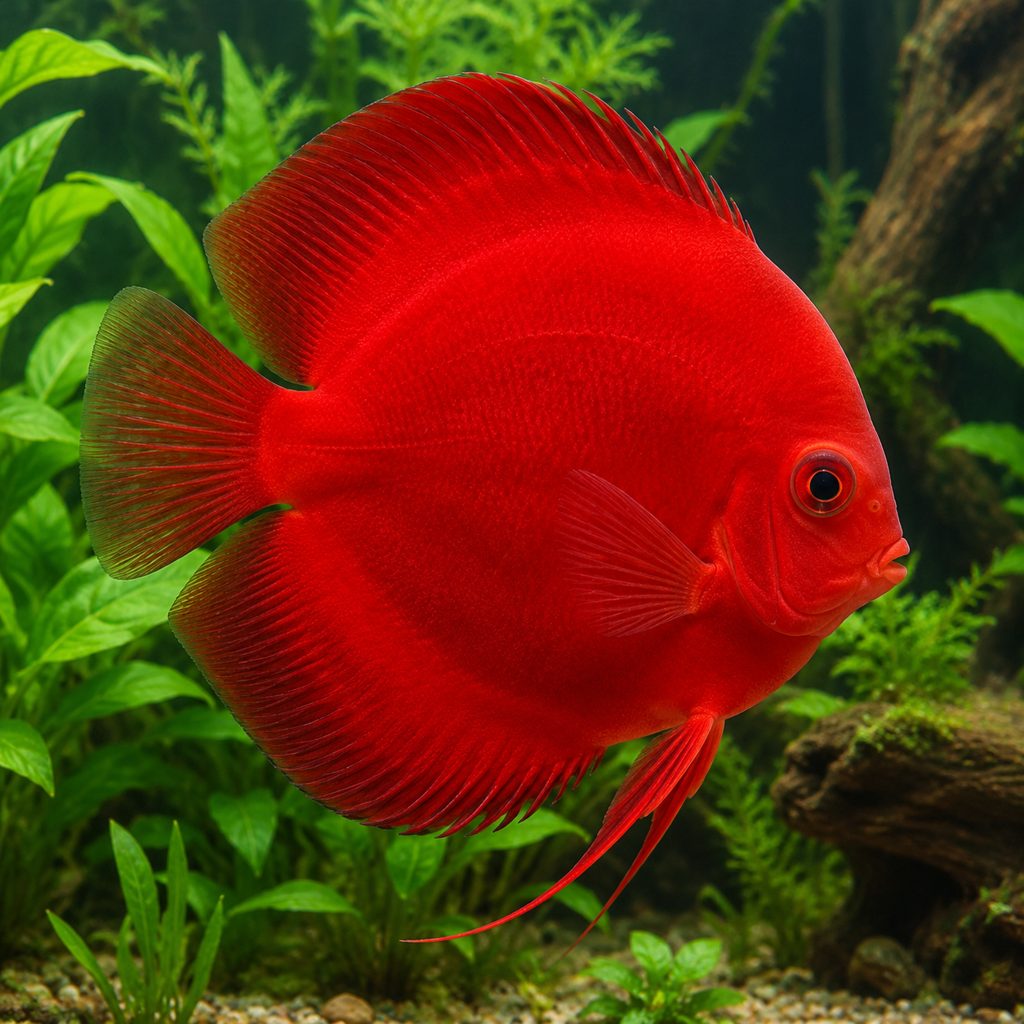
Red discus are domestic-bred fish selected for color not found in the wild Heckel, Brown or Green forms. The label covers a range of appearances: a near-solid red body, an orange or yellow gradient, or a patterned red Turquoise type. A name on a listing narrows the search, but the actual fish tells you how deep and even its red is.
Red varieties do not all look alike
| Type | What to expect |
|---|---|
| Solid Red | A mostly uniform red body; depth and evenness are central to its look |
| Sunset | A gradient shifting from red toward yellow or orange |
| Butterfly | A red- or orange-based fish with pattern spreading over the body or fins; expression varies by line |
| Red Turquoise | A red base with fine Turquoise-style patterning; density varies between individuals |
Names are not a standardized guarantee of identical markings. Compare the fish itself: a deep red tone, minimal pale patches and color carried onto the face and fins are often desirable. Adults reach 6–8 inches (15–20 cm). Like other discus, they are generally judged for a deep, near-round body, a pronounced forehead and well-developed fins.
Keep color in perspective: care comes first
Red discus use the same care targets as other domestic strains.
| Parameter | Target |
|---|---|
| Adult temperature | 82–86°F (28–30°C) |
| Juvenile temperature | 86–88°F (30–31°C) |
| pH | 6.0–7.0 |
| General hardness | 1–5°dH (dGH) |
| Adult water changes | 30–50% weekly |
| Juvenile water changes | At least 30% daily or every other day |
During the juvenile stage, high-protein food and frequent water changes support body growth. As the fish matures, make a balanced diet the foundation. Food containing color-support ingredients such as astaxanthin can supplement that diet, but it cannot turn every fish the same shade; genetics and individual condition matter. Avoid sudden changes in temperature or water quality, and maintain the planned water-change schedule.
Plan tank size around the actual adult fish and filtration, rather than relying on a fixed gallons-per-fish rule. Aqueon’s U.S.-oriented care guide recommends at least 75 gallons (about 284 L) for adult discus and prefers tall aquariums. That recommendation is a useful planning reference, not a guarantee that every aquarium can support the same group or extra tank mates.
U.S. seller names and listed prices
U.S. product catalogs may use line names beyond “Red Discus.” Discus.com’s listings include Fuji Red ($61–$184), Rose Red, Dark Base ($29–$132), F1 Ica Red ($41–$159), Classic San Merah ($113–$167) and Red Alenquer Cross ($41–$159). Those were displayed listing ranges in October 2026 from one retailer, not a representative market survey. The pages did not establish which fish size, grade or option matches each point in the range, nor confirm stock for every option at the time checked.
Use the names as catalog clues, not as a promise that every “red” line will have a solid-red body. Ask for photos of the individual fish and clarify size, current availability, shipping and price for the exact option. The listed prices do not establish shipping eligibility in every location or any legal requirement; verify details that apply where you live.
Choosing a fish that will thrive
Compare fish side by side to judge red intensity. Look for pale areas or uneven patches, then check whether color extends toward the dorsal, anal and tail fins. Do not ignore the basics: breathing should be calm, swimming should look coordinated, and the fish should respond to food. If a juvenile is less colorful than an adult, assess its condition and growth rather than expecting mature coloration immediately.
Frequently asked questions
Can food make a red discus brighter?
Color-support ingredients can be useful as part of a balanced diet, but food is not the only factor. Genetics and individual condition set limits, and stable care helps the fish show its color.
What is the difference between Sunset and Butterfly?
Sunset refers to a red-to-yellow or orange gradient. Butterfly is used for patterned red or orange fish, with markings that spread over the body or fins. They are not interchangeable names.
When does red coloration deepen?
It varies by fish, but color generally becomes more pronounced as the discus grows and matures. Keep juveniles on a growth-focused care routine instead of judging them only by adult color.
‹ Back to all articles