 The Discus | Discus Fish Care and Breeding Guide
Blue Diamond Discus: Color, Care and Where to Buy
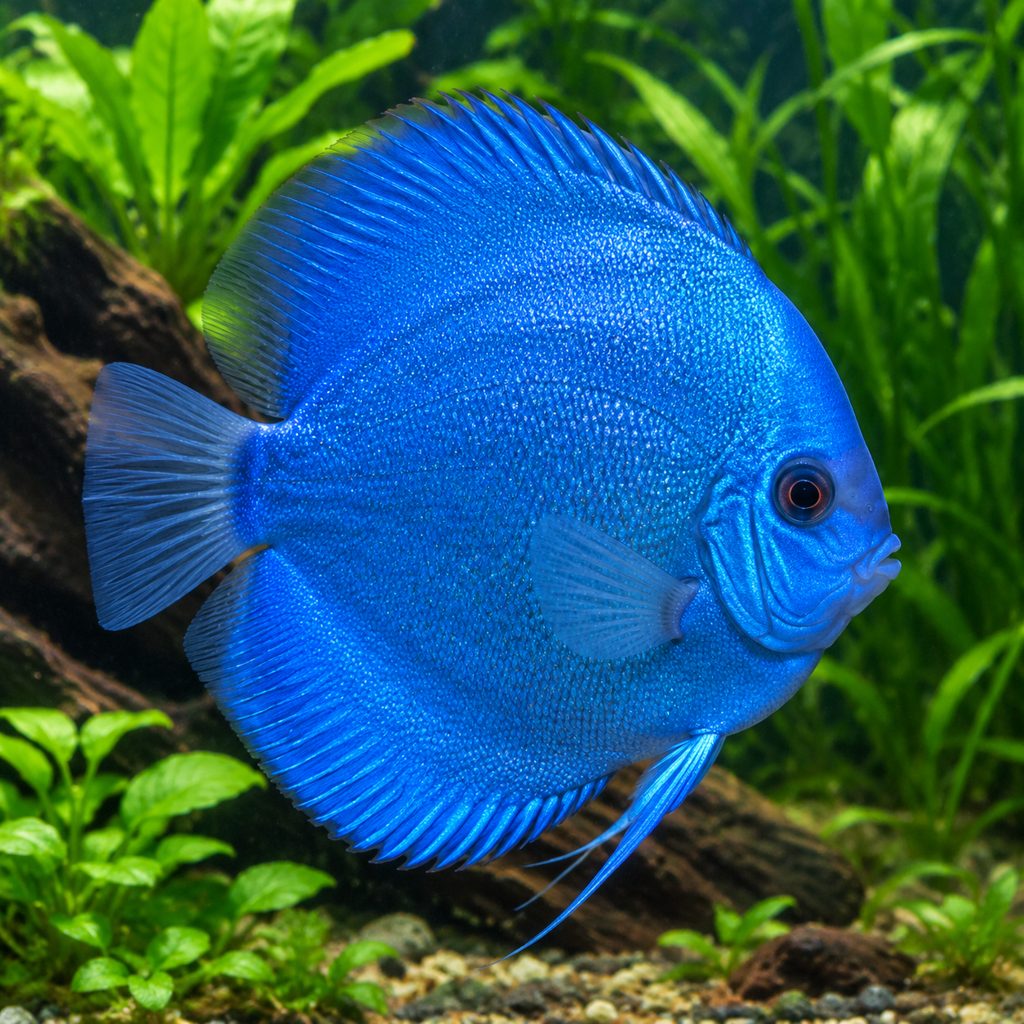
Blue Diamond discus are valued for a largely unmarked metallic-blue body. Turn the fish under aquarium lighting and the color may shift from silvery blue to a deeper, saturated shade. The strain comes from German-developed domestic lines, but the buying decision is more than a color check: look at body shape, appetite and the seller’s actual fish as well.
What makes a Blue Diamond distinctive?
The variety is bred for a solid blue appearance with little pattern. A discus can still show vertical stress bars depending on its condition, so a temporary bar is not by itself proof that the fish is the wrong strain. Judge the color when the fish is settled, and consider whether the bars persist alongside other signs of stress. The pattern is a useful clue, but it should never outweigh condition: a fish hiding, breathing hard or refusing food may be stressed or unwell regardless of how clean its blue looks. Ask the seller about its routine and look at it for more than a moment before deciding.
Adults reach 6–8 inches (15–20 cm) in total length and have the familiar disk-shaped body. A deep body approaching a circle is generally preferred, as are extended dorsal and anal fins with blue continuing toward their edges. With good care, discus may live more than 10 years—a substantial commitment for any color strain.
Care parameters for domestic discus
Blue Diamond follows the usual domestic discus targets rather than requiring a special water recipe.
| Parameter | Target |
|---|---|
| Adult temperature | 82–86°F (28–30°C) |
| Juvenile temperature | 86–88°F (30–31°C) |
| pH | 6.0–7.0 |
| General hardness | 1–5°dH (dGH) |
| Adult water changes | 30–50% weekly |
| Juvenile water changes | At least 30% daily or every other day |
Domestic strains do not need wild-discuss blackwater conditions. The wild-type pH range noted in the care source is 4.2–5.2, while domestic fish can be kept in the range above, including near neutral. Keep temperature and water quality stable. Juveniles need high-protein food and frequent water changes to support growth; for adults, continue weekly water changes and offer balanced nutrition.
Avoid treating a volume-per-fish calculation as a full stocking plan. The Japanese care guide gives 5.3–6.6 US gallons (20–25 L) per fish and mentions 4–5 discus in a 24 × 18 × 18-inch (60 × 45 × 45 cm) aquarium as a reference, not a universal stocking prescription. That footprint is in the 20-gallon tank class; its full geometric volume is about 32 gallons (121 L), but substrate and equipment reduce the actual water volume. Choose capacity for the adults, group size and filtration together. Aqueon’s U.S.-oriented discus guide recommends at least 75 gallons (about 284 L) for adults and prefers a tall aquarium.
How to choose a healthy fish
Compare several fish side by side if possible. Look for even, deep blue, a rounded body and fins that are intact and extended. A slight stress bar may come and go, so watch the fish settle rather than rejecting it on that feature alone. Ask the seller what and when it has been eating, and observe breathing, swimming and response to food. A fish sitting motionless at the edge or breathing rapidly deserves closer scrutiny.
Blue Diamond is a named variety in Discus.com’s hybrid-discus catalog, which confirms that at least one U.S.-facing seller offers it; that does not establish broad availability. The retailer’s “Classic Deep Blue Diamond Discus” page displayed $32–$155 when checked in October 2026. It also listed “High Bodied Blue Diamond Discus With Deep Blue Gene” and “Blue Diamond Discus With Deep Blue Gene,” each at $48–$155. These are one seller’s listing ranges, not market averages, and the page did not establish which fish size or option maps to each price. Confirm the selected fish, current stock, shipping terms and applicable local requirements with the seller.
Frequently asked questions
How does Blue Diamond differ from Cobalt or Turquoise?
Cobalt and Turquoise strains are associated with visible blue-green vertical patterning. Blue Diamond is selected for a more solid blue appearance, although condition-related stress bars can still appear.
Is Blue Diamond the same as Royal Blue?
No. Royal Blue is closer to a wild-type look, with vertical bars running across the body. Blue Diamond is a domestic strain selected for its reduced pattern and blue color.
Can a beginner keep Blue Diamond discus?
The strain uses the standard domestic discus parameters, but it is not a low-maintenance fish. A beginner who can maintain 82–86°F (28–30°C) for adults, stable water and the water-change routine can consider it after planning a suitable adult tank.
‹ Back to all articles