 The Discus | Discus Fish Care and Breeding Guide
Chlorine and Chloramine in Aquarium Tap Water
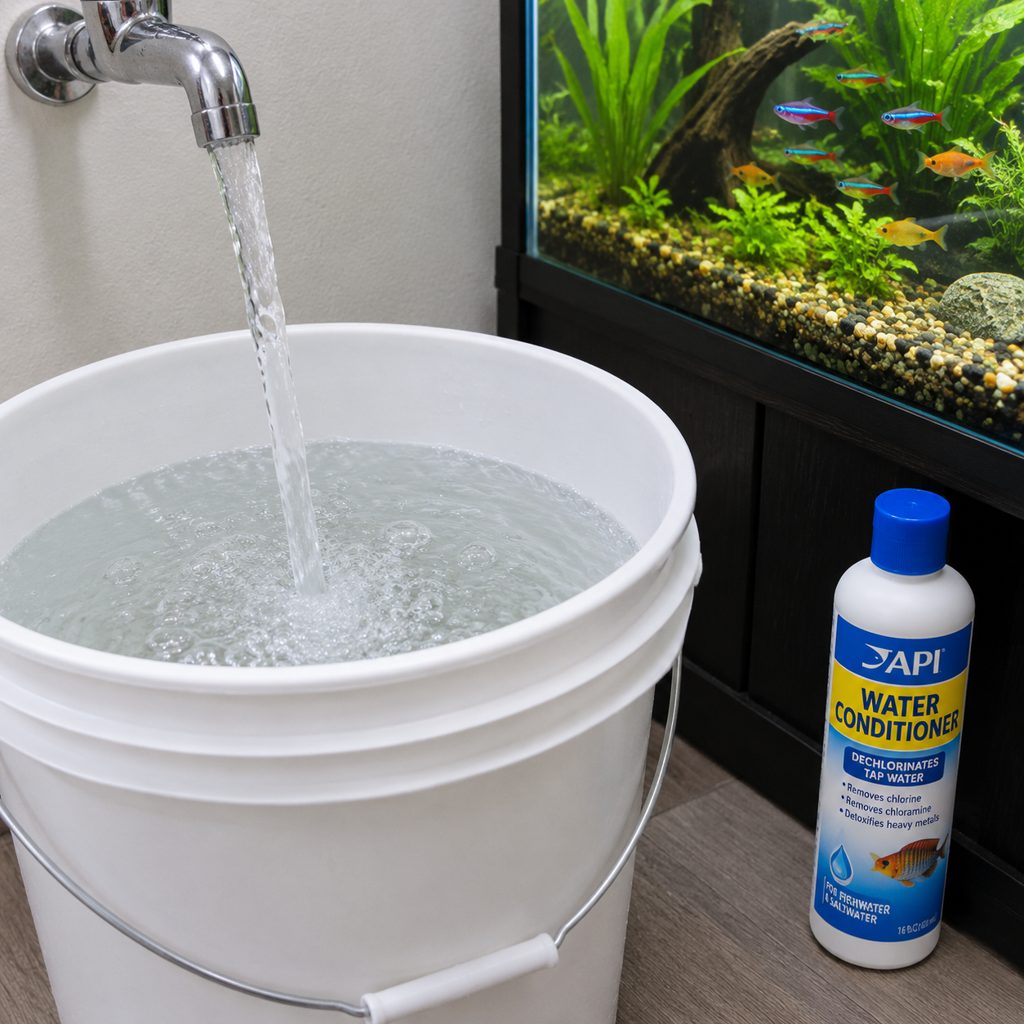
Tap water that is safe to drink is not automatically safe to pour into a discus aquarium. Before every water change, find out how your utility disinfects water and use a treatment method that addresses it. In the United States, that distinction matters: chlorine and chloramine do not behave the same way when water is left standing.
Check what comes out of your tap
Disinfectants help control microbes in municipal water, but residual disinfectant can harm a fish’s gills and protective mucus. The US EPA says water utilities use chloramines and that more than one in five Americans receives chloramine-treated water. That national figure does not tell you what is in your specific supply. Check your utility’s water-quality report or contact the provider; treatment can vary from place to place and may change.
Do not rely on smell, appearance, or the fact that yesterday’s batch seemed fine. Residual chlorine is not visible in a bucket. If you need to confirm treatment, use an appropriate test, but still follow the conditioner label and your utility’s information. Our article on discus water changes covers the full replacement-water routine.
Three ways to prepare water
| Method | Typical preparation | What to consider |
|---|---|---|
| Aquarium conditioner | A few minutes | Confirm the label covers the disinfectant in your supply and dose for the water volume |
| Aerated, stored tap water | About 24 hours | Can reduce free chlorine; do not assume it removes chloramine |
| Reverse osmosis (RO) water | Ready after production and adjustment | Contains little mineral content and needs remineralization or blending |
A conditioner containing sodium thiosulfate—often called hypo—can treat chlorine when used as directed. Products differ: verify whether the label covers both chlorine and chloramine, and check what it says about ammonia associated with chloramine treatment. More conditioner is not automatically better; measure the amount for the volume you are treating.
Aerating water with an air pump for about 24 hours can help remove free chlorine. It is not a reliable substitute for a chloramine-capable conditioner when the utility uses chloramine. An uncovered container allows gas exchange, but standing time alone should not be treated as proof that the water is safe. When the supply’s disinfectant is unknown, verify it rather than guessing.
RO water is another option when tap water is unsuitable or you want more control over source-water chemistry. Reverse osmosis removes minerals as well as disinfectants, so the resulting water is very soft and needs mineral adjustment before fish use it. Do not put untreated, mineral-free RO water straight into the discus tank as a routine shortcut.
Conditioner choices and US price examples
Read product directions for the exact water volume and application. Seachem’s Prime instructions state a standard dose of 5 mL per 50 US gallons (200 L), and the company describes the product as treating chlorine and chloramine while addressing ammonia released when chloramine is treated. Use that as an example of one manufacturer’s directions—not a dose to copy for another conditioner.
US retailers also use terms such as “dechlorinator” and “water conditioner.” Aquarium Co-Op calls its product Easy Dechlorinator, describes it as neutralizing chlorine and chloramine, and listed a 2 oz bottle for $4.99 in October 2026. A discus specialist listed 200 g of dechlorinator powder for $30. These are specific retailer listings, not average prices or proof that one product suits every water supply. Check the label for the compounds treated and the volume covered.
A US discus retailer also listed a Breeder’s Grade reverse-osmosis unit for $150 in October 2026. That is one seller’s price anchor, not a complete comparison of RO systems. Factor in replacement filters, waste water, and mineral adjustment when deciding whether RO makes sense for your setup.
A safe water-change sequence
- Fill a clean container with the amount of tap water you plan to replace.
- Add a conditioner rated for the disinfectant in your supply, using its label directions, and mix thoroughly.
- Heat the new water to the aquarium’s adult target of 82–86°F (28–30°C).
- Check that the temperature difference is within ±2°F (±1°C), then add the water slowly.
Prepare new water before adding it to the tank. If you use RO water, adjust its minerals as part of preparation. In winter, stored water can cool below the tank temperature, so check it just before refilling.
FAQ
Will leaving water out overnight remove the chlorine?
Aerating tap water for about 24 hours can reduce free chlorine, but it may not remove chloramine. Check your local utility’s disinfectant and use a conditioner that covers it when needed.
Can I use any dechlorinator for chloramine?
No. Labels vary. Confirm that the product treats chloramine and follow its directions for the water volume. Some products also address ammonia associated with chloramine treatment; do not assume all conditioners work identically.
Can I tell by looking whether the water is treated?
No. You cannot see residual disinfectant in the bucket. Use your utility’s water report and a suitable test if needed, then follow a consistent preparation routine.
Is RO water ready to use as soon as it comes out of the unit?
Not for discus as-is. RO water has very little mineral content, so remineralize or blend it appropriately before use and match its temperature to the aquarium.
‹ Back to all articles