 The Discus | Discus Fish Care and Breeding Guide
Discus Water Changes: How Often and How Much?
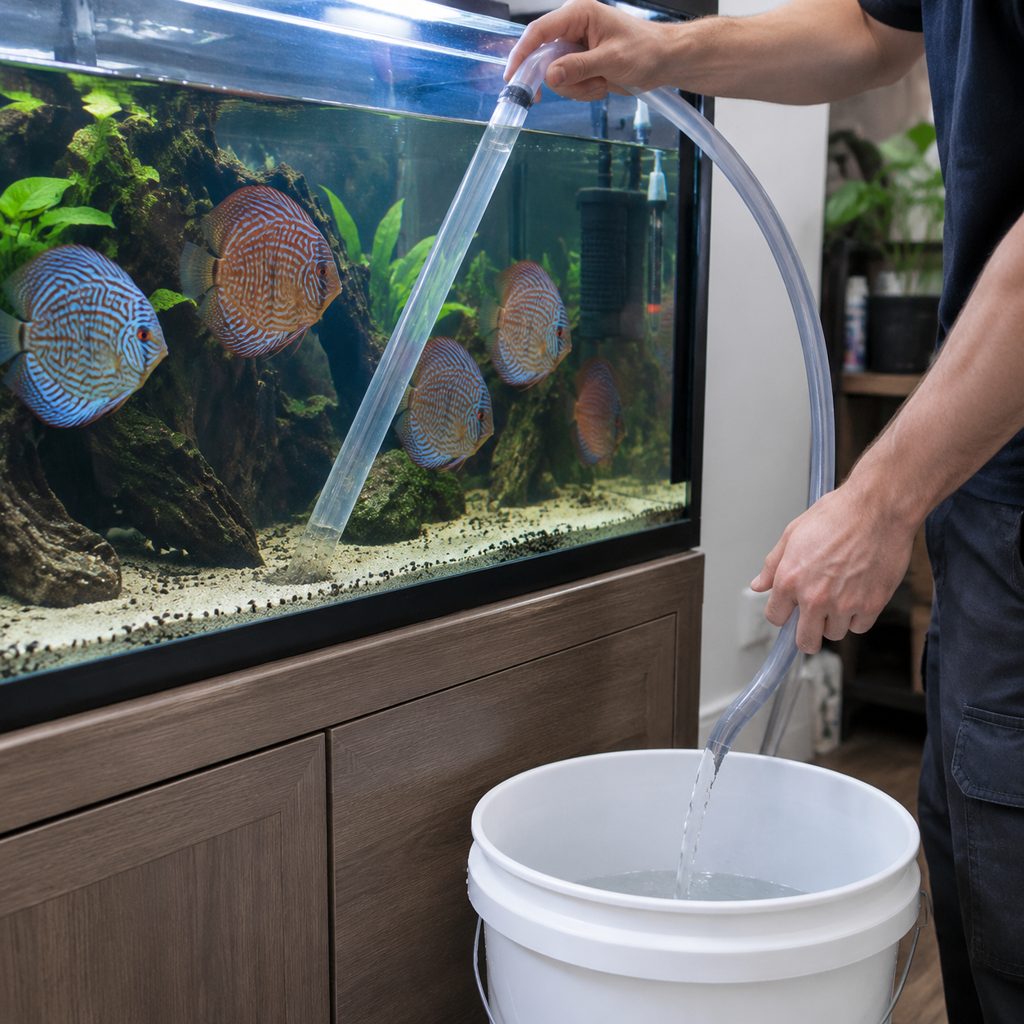
Warm water and generous feeding make a discus aquarium a steady waste-producing system. A filter processes ammonia and nitrite, but nitrate continues to build up. Water changes dilute it and remove debris. The right schedule depends on stocking, feeding, and the fish’s life stage; use a repeatable baseline, then adjust based on test results and how quickly the tank gets dirty.
Use a starting schedule, not a rigid rule
| Situation | Starting frequency | Amount per change |
|---|---|---|
| Adult routine care | Once a week | 30–50% of aquarium volume |
| Juvenile grow-out | Daily to every other day | At least 30% |
| Breeding period | Daily to every other day | About 30% |
These are husbandry starting points, not a verified US-wide consensus. A small aquarium with little water per fish or heavy feeding may need more frequent changes. Check nitrate and the fish’s condition, and keep a log of the amount and schedule. Increase frequency or volume gradually rather than making a sudden change in routine. For juveniles, frequent water changes are often discussed as part of growth-oriented care, but clean, stable water remains the practical goal.
Prepare replacement water for your local supply
US municipal water is not treated identically everywhere. The EPA reports that more than one in five Americans receives chloramine-treated water. Check your utility’s water report and select a conditioner labeled for the disinfectant in your supply; do not assume that leaving water to stand removes chloramine.
A US aquarium retailer listed a 2 oz bottle of Easy Dechlorinator at $4.99 in October 2026. That is one listing price, not a standard price. Seachem Prime’s instructions address chlorine and chloramine and specify 5 mL for 50 US gallons (200 L) as its standard dose. Follow the label for the product you use; never transfer one brand’s dosage to another. If your source water is difficult to manage, reverse osmosis is another option. A discus specialist listed an RO unit at $150, a single retailer snapshot; RO water needs mineral adjustment before use.
Before draining the aquarium, prepare the new water:
- Fill a clean bucket or water-change container with tap water.
- Add a conditioner that treats your utility’s disinfectant, following its label, and mix well.
- Heat the water to match the aquarium’s 82–86°F (28–30°C) adult range.
- Confirm the replacement water is within ±2°F (±1°C) of the tank.
Conditioning and temperature matching go together. A large volume of untreated or much colder water can stress fish. Our article on residual chlorine and water conditioners compares treatment options in more detail.
Siphon and refill at a calm pace
Use a siphon to remove water while vacuuming waste and uneaten food from the bottom. Pay attention to corners and spaces behind driftwood where debris settles. Add prepared replacement water slowly over several minutes, then check that the heater, filter, and other equipment are running. A consistent procedure makes it easier to spot a problem after maintenance.
Keep soap, household cleaners, and other chemicals away from buckets and hoses used for the aquarium. Wash your hands before starting. If discus darken or gasp after a change, check for a temperature mismatch and confirm the disinfectant was treated; observe the fish and test the water rather than assuming one cause.
Avoid full water changes as routine maintenance. Replacing all the water at once can shift temperature and chemistry abruptly. Partial changes are the standard approach; a full change belongs only to exceptional situations where there is a specific reason and a plan to manage the disruption.
FAQ
Do adult discus need water changes every day?
Not necessarily. A weekly 30–50% change is a starting point for routine adult care. Juveniles and breeding fish may need daily-to-every-other-day changes. Adjust the schedule to measured water quality and feeding load.
My discus darken after a water change. What should I check?
Review temperature matching, water chemistry, and whether the conditioner treated the disinfectant in your tap water. Persistent dark color or abnormal breathing calls for a closer check of the fish and tank conditions.
Can I just let tap water sit overnight?
That depends on the disinfectant. EPA reports chloramine use in US drinking-water systems, and simply standing water should not be assumed to remove it. Check your utility report and use a compatible conditioner when needed.
Should I ever replace all the water?
Partial changes are the routine method. A full change can create a major environmental shift, so reserve it for unusual situations rather than ordinary upkeep.
‹ Back to all articles