 The Discus | Discus Fish Care and Breeding Guide
Choosing a Discus Tank: Size, Filtration, and Setup
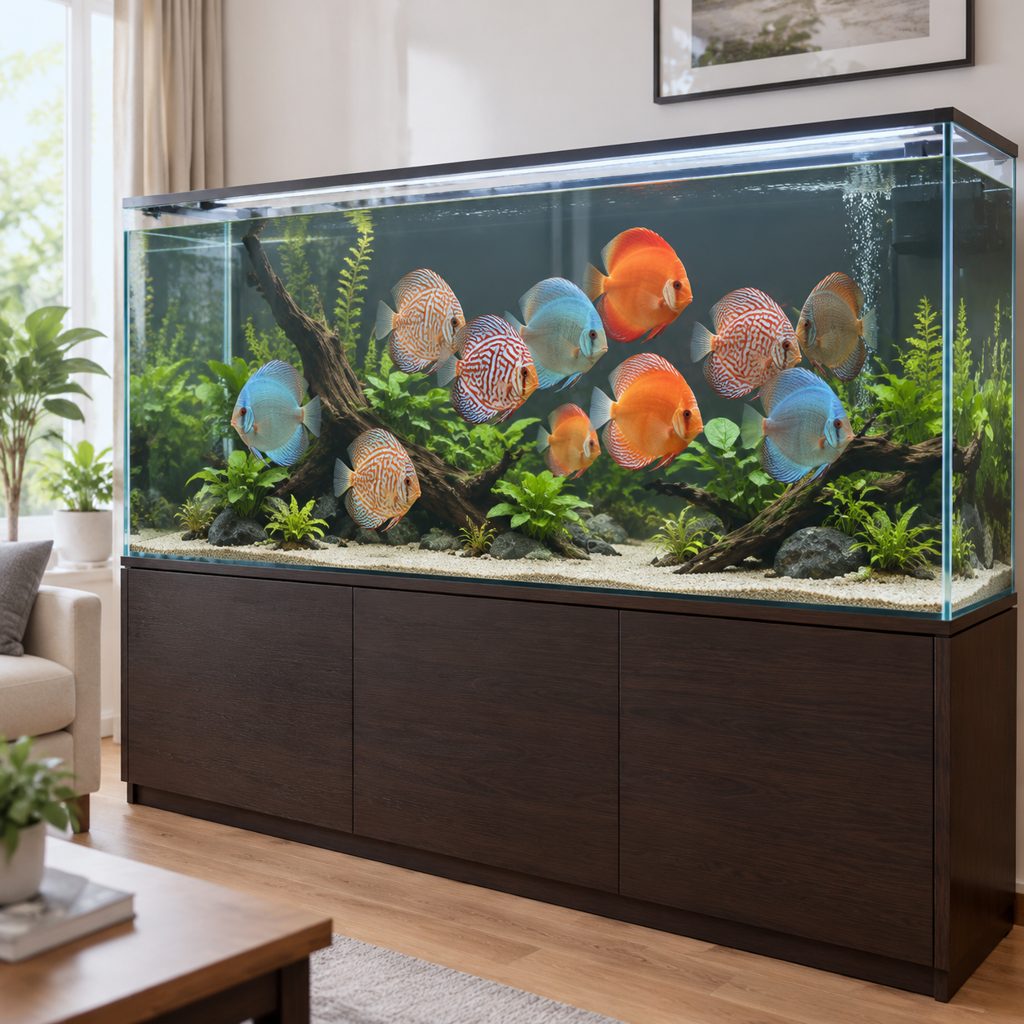
Choose the aquarium for the adult fish you plan to keep, not the juveniles you see at a store. Discus grow to about 6–8 inches (15–20 cm), and a crowded tank with weak filtration can turn feeding and cleanup into a daily struggle. Plan around water volume, adult group size, filtration, and your room’s ability to support a heavy, heated aquarium.
Size the aquarium for the group
A useful planning allowance is 5.3–6.6 US gallons (20–25 L) per adult. Discus are social and tend to settle better in a group, so the long-term setup should be planned for at least four or five fish rather than a single showpiece. Tank names such as “20-gallon” are broad classes, not a promise of capacity: depth and height change the actual volume substantially.
| Example footprint | Approximate capacity | Suggested use |
|---|---|---|
| 18 × 12 × 12 in (45 × 30 × 30 cm) | About 10.5 gal (40 L) | Temporary juvenile grow-out |
| 24 × 18 × 18 in (60 × 45 × 45 cm), roughly 24-in/20-gal class | About 29–32 gal (110–120 L) | 4–5 adults |
| 36 × 18 × 18 in (90 × 45 × 45 cm), roughly 36-in/40-gal class | About 48 gal (180 L) | 6–8 adults |
The middle example is deeper than many standard 24-inch aquariums, which is why its volume is closer to 30 gallons than a typical 20-gallon class tank. A shallower 24 × 12 × 14 in (60 × 30 × 36 cm) tank holds about 16 gallons (60 L), so it needs a more conservative stocking plan. Use the actual dimensions and usable water volume, not the length label alone. The 18-inch tank is a nursery or temporary grow-out option, not an adult home.
Filtration and maintenance access
A canister filter is a practical choice for a warm, well-fed discus aquarium. Aim for rated flow of 3–5 times the tank volume per hour. For a 32-gallon (about 120 L) setup, that is roughly 95–160 gallons per hour (360–600 L/h). Combine mechanical media to catch debris with biological media for beneficial bacteria. Rinse filter media in water taken from the aquarium; untreated tap water can disrupt the biofilter. If flow drops, inspect the intake and clean the media as needed.
Other filter styles can work if they provide enough biological capacity and flow, but the sources here do not establish which style is most common among US discus keepers. Buy for the load you plan to maintain, not a claim that one technology is universally required. Leave room to reach the filter, siphon, and heater without dismantling the display.
A US discus retailer listed a Premier 300 Pro Clear wet/dry filter at $440 in October 2026. That is one product listing, not a typical equipment budget or proof that wet/dry filters dominate the hobby. The same specialist listed an H2O Pro digital controller/heater combo at $80–$100 and a reverse-osmosis unit at $150. Prices and stock are retailer-specific snapshots. Discus-related equipment is also sold online, and one specialist describes direct-to-customer fish shipping within the US by UPS Priority Overnight or Delta Cargo Dash.
Heat, light, and the bottom of the tank
| Tank length | Heater capacity guide |
|---|---|
| 24 in (60 cm; roughly 20-gallon class) | 150–200 W |
| 36 in (90 cm; roughly 40-gallon class) | 250–300 W |
Use a thermostat and maintain 82–86°F (28–30°C) for adults. Allow headroom for cold weather and consider how you will respond if a heater fails. Moderate or subdued lighting is a good starting point; bright light may make fish uncomfortable. A lid helps hold heat, reduces evaporation and dust, and lowers jump risk.
Bare-bottom aquariums are popular with discus keepers because waste and leftover food are easy to see and siphon. Substrate, plants, and driftwood can make a display more natural, but debris becomes harder to spot and remove. Choose the look you want while leaving a shaded retreat and enough clear floor space for routine cleaning.
Mature the filter before stocking
A few weeks of running an empty tank does not prove the biofilter can handle fish waste. Establish the biological filter with an ammonia source and verify that it can process ammonia and nitrite back to zero before adding discus. Stock only after the tank is stable, then monitor readings as feeding and the fish load increase.
FAQ
How many discus fit in a 24-inch tank?
It depends on its depth and height. The 24 × 18 × 18 in (60 × 45 × 45 cm) example is about 29–32 gallons and is a guide for 4–5 adults. A shallow 24-inch tank with about 16 gallons needs fewer fish.
Can I use a hang-on-back or sponge filter?
Possibly, if the system provides adequate biological capacity and 3–5 tank volumes of rated hourly flow. A canister is a straightforward option, but match the filter to the waste load and keep up with maintenance.
Can discus live in a planted tank?
Yes. Choose plants that tolerate 82–86°F (28–30°C) and moderate-to-low light, then account for the extra work of removing debris around plants and hardscape.
‹ Back to all articles